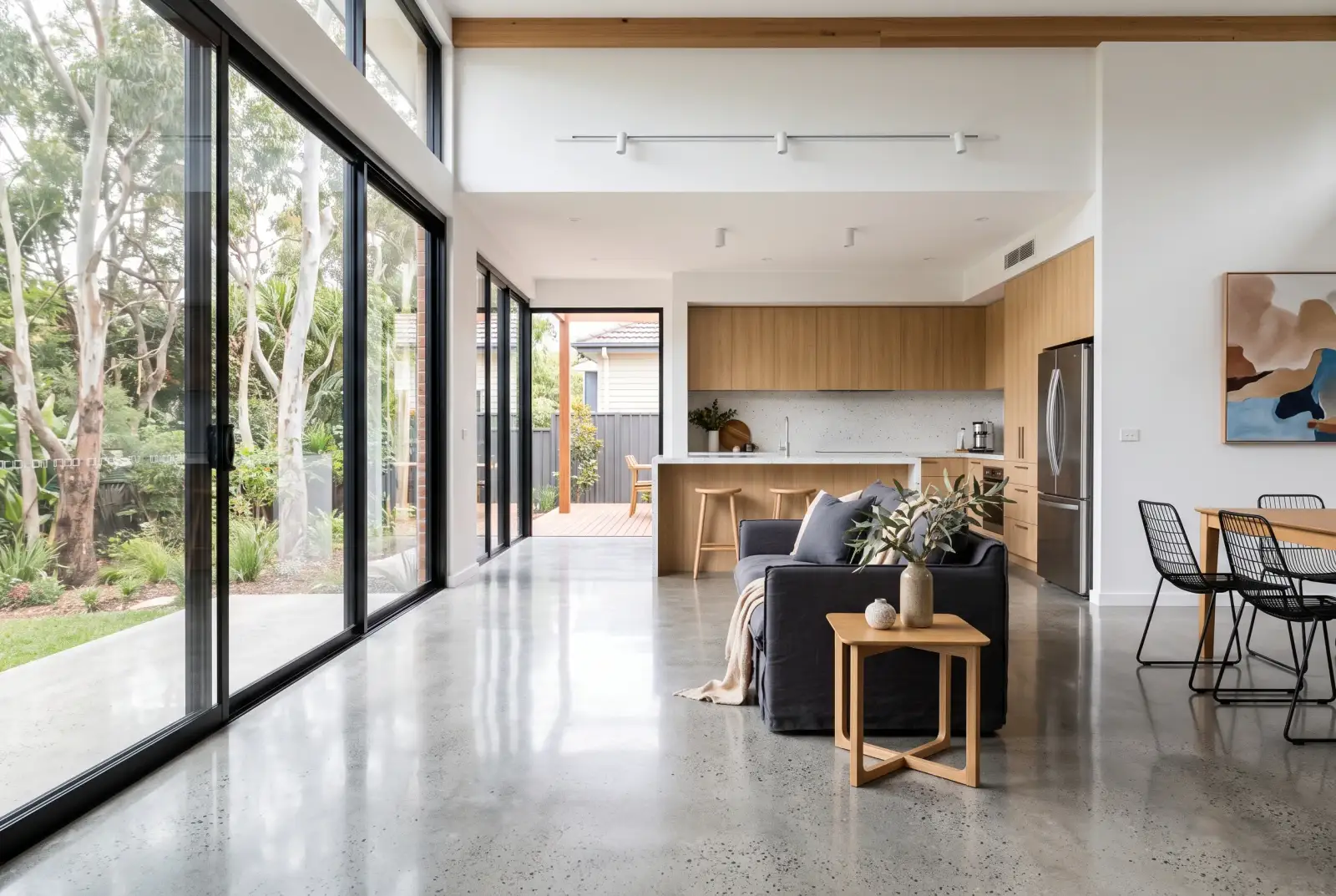
Polished concrete is a floor that is made by mechanically grinding and honing a concrete slab to a smooth, hard-wearing surface — not a coating you roll on top. Done well it gives you a low-maintenance, long-lasting floor with real depth and character, and after 25 years working with concrete across the Adelaide Hills and beyond, we are asked about it more every year. Here is a plain-English guide to what polished concrete actually is, where it suits, and where a simpler finish makes more sense.
What polished concrete actually is
Polished concrete is concrete that has been ground back and progressively honed with finer and finer diamond tooling until the surface takes on a sheen. The key thing to understand is that the polish comes from the slab itself — you are refining the concrete you already have, not adding a separate layer of plastic or paint on top. That is the fundamental difference between true mechanically polished concrete and a topical coating.
The process runs through grit stages, much like sanding timber from coarse to fine. Each pass cuts a little finer, closing the surface and lifting the gloss. Along the way the floor is usually treated with a chemical densifier (a liquid hardener) that reacts inside the concrete to make it denser and more abrasion-resistant. Because the finish is part of the slab, it cannot peel or delaminate the way a coating can — there is nothing to lift off.
This is worth contrasting with the two finishes people most often confuse it with:
- Grind-and-seal: the slab is ground to expose the look you want, then a topical sealer (acrylic, polyurethane or epoxy) is applied over the top to give the sheen and protection. Faster and cheaper than full polishing, but the sealer is a wear layer that will eventually need recoating.
- Epoxy floors: a thick resin coating poured or rolled over the slab. Hard-wearing and good for chemical resistance in workshops, but it is a coating sitting on the concrete, not the concrete itself.
- Mechanically polished concrete: no topical film. The shine is in the densified, honed slab. The most durable of the three, and the most involved to produce.
Grind levels, gloss and aggregate exposure
The look of a polished floor is set by two choices: how much aggregate you expose, and how high you take the gloss. These are decided separately, so you can have a low-sheen floor with lots of stone showing, or a glassy floor with almost no aggregate at all.
Aggregate exposure — how much stone you see
When the grinder cuts into the slab, the deeper it goes, the more of the stone (aggregate) within the concrete it reveals:
- Cream (no grind / light cut): the polish stays in the top paste layer, so you see very little stone — a smooth, fairly even surface with only the natural variation of the cement. The most forgiving and the cheapest level.
- Salt-and-pepper: a slightly deeper cut exposes the tips of the sand and small stones, giving a subtle speckle through the floor. The most popular choice for homes — it has interest without being busy.
- Full aggregate (full stone): the grinder goes deep enough to expose the larger stones across the whole floor, giving a terrazzo-like look. Striking, but it demands a well-batched slab and is less forgiving of variation.
Because full-stone exposure relies entirely on the aggregate in the mix, the look is locked in the day the slab is poured. If you want a consistent full-aggregate finish, the mix and the placement have to be planned for it before the concrete arrives — you cannot add it later.
Gloss level — matte, satin or high-gloss
The gloss is set by the final grit stages and any guard or burnishing applied at the end:
- Matte: a soft, flat finish with little reflection. Hides marks and footprints best and feels understated.
- Satin: a low-to-medium sheen — a clear step up in depth without a mirror finish. A sensible middle ground for living areas.
- High-gloss: a reflective, almost wet look. It shows off the aggregate and light beautifully but also shows every smudge, so it suits showrooms and feature spaces more than a busy family kitchen.
Where polished concrete suits — and where it doesn't
Polished concrete shines in new-build homes poured on a slab, in alfresco and indoor-outdoor areas, and in commercial or retail spaces where durability and a clean look matter. It works best where you are planning the floor from the slab up, because the quality of the finish depends so heavily on the quality of the base.
Good fits include:
- New homes on a slab-on-ground: the slab is both your structure and your finished floor, which can save the cost of tiles, timber or carpet entirely.
- Open-plan living, kitchens and alfresco: the seamless surface and thermal mass suit big spaces and indoor-outdoor flow.
- Workshops, sheds and garages: a hard, sealed surface that sweeps clean and shrugs off tools, tyres and foot traffic.
- Retail, cafes and commercial fit-outs: hard-wearing, low-maintenance and easy to keep looking sharp under heavy traffic. This is core commercial concreting territory.
The thermal mass point is a genuine advantage in a lot of South Australian homes. A concrete floor soaks up warmth during the day and releases it slowly, which can help even out temperature swings — particularly useful in the colder Hills and in properties out through the Mid North and around Morgan where days and nights can be a long way apart.
The pros and cons, honestly
The biggest advantage of polished concrete is that it is one of the most durable, lowest-maintenance floors you can have, but the trade-offs are real and worth knowing before you commit. Here is the balanced picture we give every client.
The pros:
- Durability: a properly densified and polished slab will outlast most floor coverings by decades.
- Low maintenance: no grout to scrub, no boards to re-coat. A regular sweep and damp mop keeps it right.
- No coverings to replace: the floor is the finish, so there is no carpet to wear out or tiles to crack and re-lay.
- Thermal mass and light: it helps store and release warmth, and a polished surface bounces natural light deeper into a room.
- Hygiene: a seamless, sealed surface gives dust and allergens nowhere to gather.
The cons:
- Hard underfoot: it is concrete. It is unforgiving on dropped glassware and can be tiring to stand on for long stretches — rugs in key spots help.
- It needs a good slab: the finish only ever looks as good as the concrete beneath it. Poor placement, surface defects or patchy curing all show up under the grinder.
- Cracks and joints show: control joints are visible by design, and any cracking that develops will be on display rather than hidden under a covering.
- Up-front cost and timing: full polishing is labour-intensive and best planned into a build rather than retrofitted.
Why the base slab and joints matter so much
With polished concrete, the slab is the floor, so getting the base right is not optional — it is the whole job. A polished finish exposes the quality of the concrete and the workmanship, which is exactly why we put so much emphasis on the pour itself. If you want to understand what goes into a good slab, our guides on how to prepare for a concrete pour and why concrete cracks and how we prevent it are a good place to start.
Two things matter most:
- Mix and placement: a consistent, well-compacted slab with even aggregate distribution gives a uniform polish. Cold joints, bleed water problems and surface dusting all become visible defects once polished.
- Joint placement: control joints are planned, not random — they tell the slab where to crack so it doesn't crack where it likes. On a polished floor, joint layout becomes a design decision, because you will see those lines for the life of the floor. Good planning puts them where they read as deliberate.
This is why a polished floor is best discussed before the slab is poured. Whether it is a house slab or a shed slab, the decisions made at the slab stage set the ceiling on how good the finished floor can be.
Sealing, densifying and ongoing care
Even a fully polished floor is treated with a densifier and usually a penetrating sealer or guard to lock in stain resistance and sheen. The densifier hardens the slab from within; the guard sits at the surface and helps the floor resist spills and everyday marking. Unlike a coated floor, there is no thick film to peel, but the guard does benefit from a refresh over the years in high-traffic areas.
Day-to-day care is simple: sweep or dust-mop regularly, damp-mop with a pH-neutral cleaner, and wipe spills promptly — especially anything acidic like wine or citrus, which can etch concrete if left. For more on keeping concrete looking good, see our guide on how to clean concrete and remove stains. If you are weighing up colour as well as finish, the coloured concrete options for SA homes guide covers oxides and dyes that can be worked into a polished or sealed floor.
For sheds and garages, often grind-and-seal is the smarter call
In most sheds and garages, a grind-and-seal or a burnished finish gives you 90% of the look for a fraction of the cost and fuss — and that is usually the right choice. A workshop floor does not need a mirror polish; it needs to be hard, sealed, easy to sweep and able to cope with oil, tyres and dropped tools. A grind-and-seal delivers exactly that, and the sealer can be recoated down the track without re-polishing the whole floor.
A burnished finish (sometimes called a power-trowelled or "burnished" slab) takes a freshly placed slab and works the surface tight and smooth as it sets, then seals it. It is a cost-effective way to get a clean, hard floor in a new shed without a separate polishing process. For more on this, our piece on concrete carport and garage slabs walks through the options. If the floor is going to be a feature you stand on every day in the house, full polishing earns its keep; in a shed, grind-and-seal usually wins on value.
If you are after the decorative stone look outdoors rather than a polished indoor floor, exposed aggregate is a different and often better fit — and you can carry the same design thinking through to the driveway, as we cover in concrete driveway design ideas for SA.
What it costs and how to plan
Polished concrete pricing varies widely with the grind level, gloss, floor size, slab condition and how much grinding access there is, so there is no single number that fits every job. The honest answer is that a simple grind-and-seal in a new shed and a full-aggregate, high-gloss polish through a custom home sit a long way apart. Because the finish depends so much on the slab, the most accurate quote comes from looking at the actual slab and talking through the look you are chasing. The related shed slab cost guide gives a sense of the base-slab side of the budget, which is the foundation of any polished-floor cost.
Frequently asked questions
Is polished concrete cold and hard underfoot?
It is hard — it is concrete — and it can feel cool, though that same thermal mass means it holds warmth from sun or heating and releases it slowly, so it is rarely as cold as people expect once a room is up to temperature. The hardness is the bigger consideration: it is unforgiving on dropped items and tiring to stand on for long periods, which is why rugs in kitchens and living zones are a common and easy fix. With underfloor heating built into the slab, a polished floor can actually be one of the more comfortable options in a cold-climate Hills home.
Can an existing shed slab be polished?
Sometimes — but it depends entirely on the condition of the slab. An existing shed slab can often be ground and sealed to give a clean, hard, attractive floor, and that is usually the practical route. A full mechanical polish is harder to guarantee on an old slab because you cannot control how it was mixed, placed or cured, and grinding can reveal patchy aggregate, cracks or surface defects that were hidden under dust and dirt. The best approach is to have the slab assessed in person: in many cases a grind-and-seal gets a great result, while a full polish is best reserved for a new slab planned for it from the start. Get in touch and we will tell you honestly what your slab will and won't do.