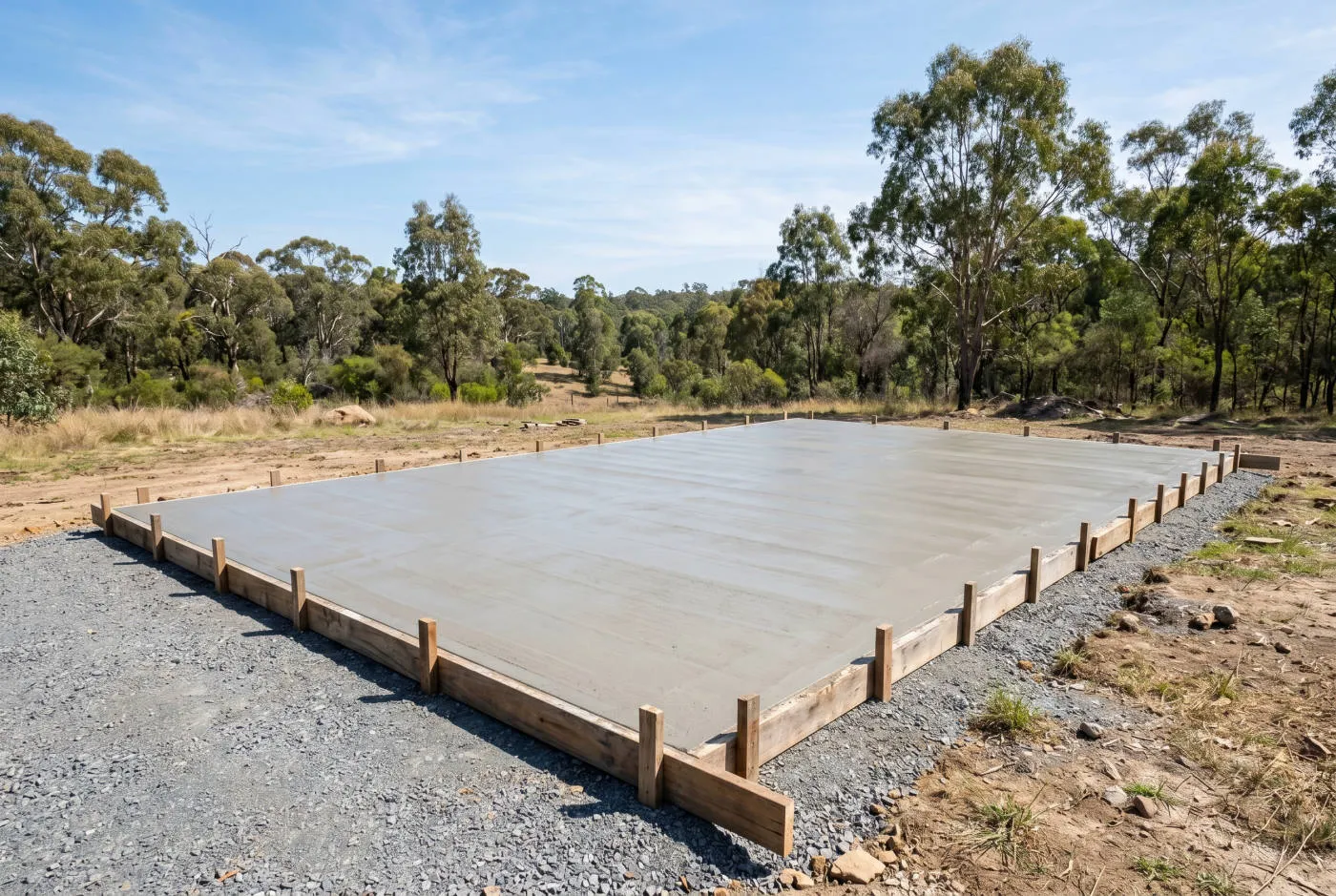
Let us be upfront: all concrete moves, and almost all concrete will develop some fine cracks over its life. That is not a sign of bad work — it is the nature of the material. The real difference between a good slab and a bad one is not whether it cracks at all, but whether the cracking is controlled, hidden and harmless, or random, wide and structural. Here is what causes concrete to crack and exactly how we manage it.
Concrete shrinks as it cures
As fresh concrete cures, it loses a small amount of moisture and shrinks slightly. Because the slab is held in place by the ground and its own edges, that shrinkage creates internal tension — and concrete is strong in compression but weak in tension. When the tension exceeds what the concrete can handle, it relieves the stress the only way it can: by cracking. This shrinkage is unavoidable, so the job is not to stop it but to decide where the cracks go.
Control joints: cracking by design
This is the single most important crack-control tool we have. Control joints are the straight lines you see cut into driveways and slabs. They create a deliberate weak point so that when the concrete shrinks, it cracks neatly down inside the joint where you cannot see it, rather than wandering across the surface. Getting the spacing and depth right is a skill — joints that are too far apart or too shallow let cracks form between them. We plan joints before we pour, cut them at the correct spacing for the slab thickness, and do it at the right time so they actually do their job.
Reactive soils, the SA challenge
The biggest cause of serious cracking in our region is ground movement, and South Australian soils are some of the most reactive in the country. The clays through the Adelaide Hills swell when wet and shrink when dry, lifting and dropping with the seasons. Out through the Mid North and around Morgan, long dry spells and sudden rain put slabs through repeated cycles. If a slab is not built to cope with this movement, the ground will eventually crack it. That is why the base and the steel matter so much.
The base does half the work
A slab is only as good as what it sits on. Poor compaction, soft spots, or fill that has not been prepared properly will settle unevenly, and an unevenly supported slab cracks. Before any pour we strip the site, set the levels, and build and compact a stable crushed-rock base. On reactive or difficult ground we may go further with the preparation. Our earthmoving and site prep is done by the same crew that pours the slab, so nothing is lost in handover between two contractors.
Steel reinforcement holds it together
Reinforcement does not stop concrete cracking — it holds the slab together if it does, keeping any crack tight and structurally sound rather than letting it open up. The key is placing the steel in the right part of the slab, chaired up off the base so it sits where it actually carries load. Steel left lying on the ground does almost nothing. We size and place mesh or bar to suit the use, whether that is a footpath, a driveway, or a heavy rural machinery pad.
The right thickness and mix
A driveway built to footpath thickness will crack under a car, and a slab that has to carry a loaded truck needs more again. Matching the thickness, the mix and the reinforcement to the real-world load is fundamental. We also manage the pour itself — avoiding adding extra water on site, which weakens the mix, and timing pours to avoid the worst of the heat. Our thickness and drainage guide goes into the numbers.
What you can do
Once a slab is down, you can reduce the risk of movement-related cracking by keeping water under control: direct downpipes and run-off away from the edges, avoid letting irrigation constantly soak the ground beside the slab, and do not plant large trees right next to it where roots can lift it. Beyond that, a properly built slab simply does its job. If you are planning new work and want it built to handle our soils, get in touch for a free quote and honest advice.
Should you worry about hairline cracks?
Not every crack is a problem. Fine hairline cracks are extremely common in concrete and are usually cosmetic — the result of normal shrinkage as the slab cures. What matters is whether a crack is widening, stepping (one side lifting above the other) or letting water into the base. Those signs point to ground movement or a base issue rather than simple shrinkage, and they're worth getting looked at. If you're unsure which kind you have, we're happy to take a look and tell you straight whether it's cosmetic or something to address.
Building for reactive ground from the start
The best crack control happens before the pour. On the reactive clays common across the Adelaide Hills and Mid North, that means a properly compacted base, reinforcement chaired into the right part of the slab, control joints at sensible spacing, and curing that isn't rushed. Get those right and the inevitable movement is managed rather than destructive — which is exactly how we approach every driveway and slab we pour.
The main types of cracks, explained
Not all cracks mean the same thing, and telling them apart helps you know whether to worry. Shrinkage cracks are fine, hairline cracks that appear as the slab cures and gives up moisture — they are extremely common and usually cosmetic. Crazing is a network of tiny surface cracks, like crackle glaze, caused by the surface drying too quickly; it is a surface-only issue. Settlement cracks appear when the ground beneath moves or was poorly compacted, and these can be structural. Structural cracks are wider, may step or open up, and point to load or base problems. The first two are about finish; the last two are about what is happening underneath, which is why we always look at the base and drainage, not just the surface.
Why control joints matter so much
Concrete shrinks slightly as it cures and moves with temperature and ground moisture for its whole life — so the question is never "will it move?" but "where will it crack when it does?" Control joints answer that. By cutting deliberate lines of weakness at sensible spacing, we direct any cracking to follow those neat, straight joints instead of wandering randomly across the surface. Skip the joints, or space them wrongly, and the slab decides for itself, usually in the most visible spot. Proper jointing is cheap insurance and one of the clearest signs of an experienced crew.
What you can do to prevent cracks
Most crack prevention is the concreter's job, but owners can help the slab live a long life. Keep water moving away from the edges so the base stays stable, deal with blocked drains promptly, avoid putting heavy point loads (like a jack or trailer stand) on thin sections, and don't plant large trees right beside a slab where roots and soil moisture changes can lift it. On a reactive Hills block, consistent soil moisture is your friend — wild swings between bone-dry and saturated are what move the ground the most.
Common questions about concrete cracking
Are hairline cracks a defect? Usually no — fine shrinkage cracks are normal and don't affect performance. Can cracks be repaired? Yes, many can be filled or sealed; structural cracks need the underlying cause addressed first. Will reinforcement stop cracks? It won't prevent them, but it holds any cracks tightly closed so they stay fine and stable. Why did my driveway crack and my neighbour's didn't? Often a difference in base preparation, jointing, slab thickness or soil — the things you can't see once it's poured.
The bottom line on cracking
Concrete moves — that is simply its nature — so the goal is never to eliminate cracking entirely but to control it so any cracks stay fine, stable and out of sight. That control is built in before and during the pour: a compacted base, correctly placed reinforcement, well-spaced control joints and unhurried curing. Skip those fundamentals and the slab decides for itself, usually in the worst spot. Do them properly — as we do on every driveway and slab across the Adelaide Hills and Mid North — and you get concrete that handles our reactive soils and stays sound for the long haul.