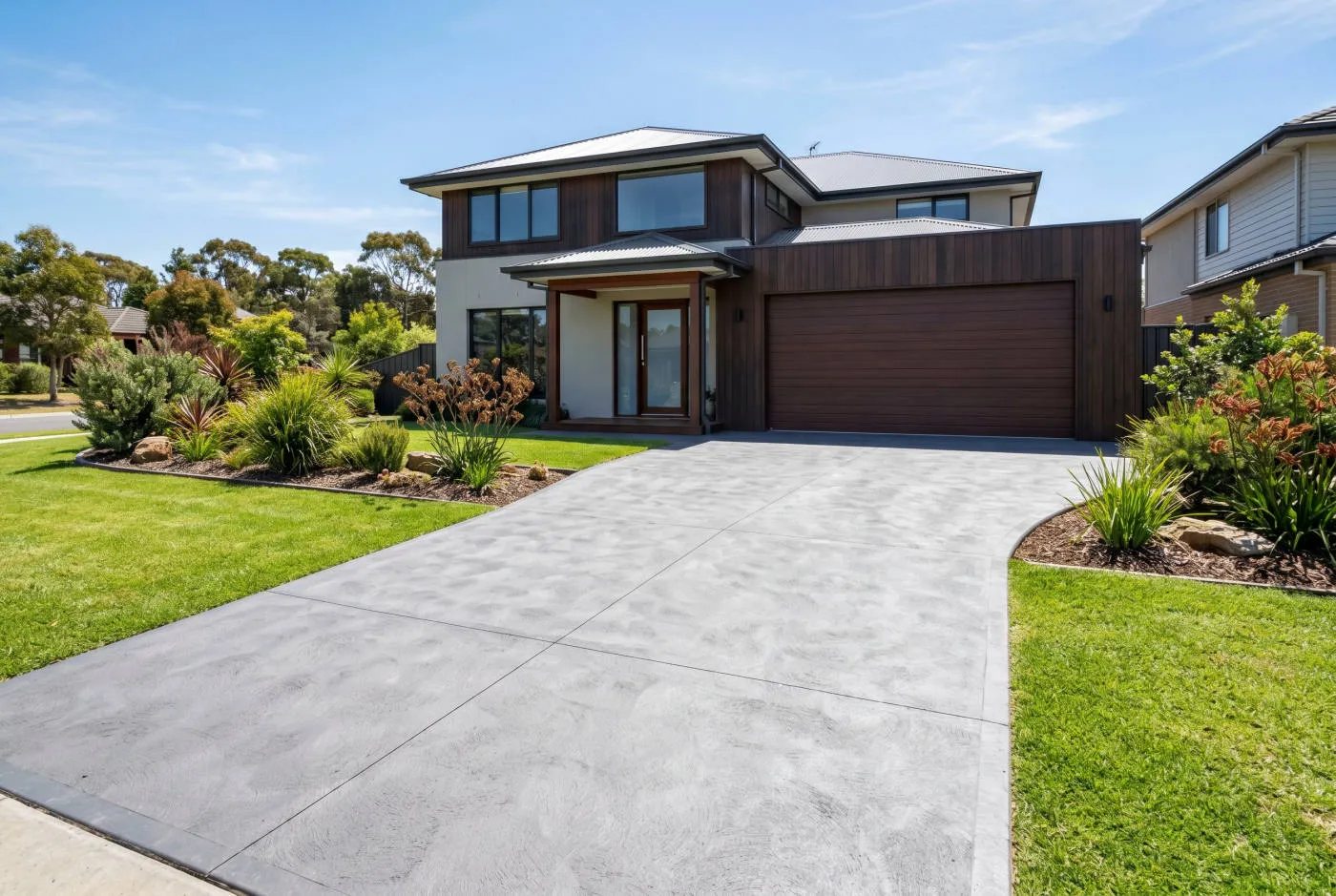
A concrete driveway should give you decades of service, but weather, tree roots and our reactive South Australian soils all take their toll. Here's what we look for when a homeowner asks whether to repair or replace.
1. Wide or spreading cracks
Hairline cracks are normal and usually cosmetic. But cracks wider than about 5mm, cracks you can feel a lip across, or cracks that keep spreading point to base or reinforcement problems that a patch won't fix.
2. Sinking or lifting sections
If slabs have dropped, lifted or rock underfoot, the base beneath has moved or washed away. Once the sub-base fails, the surface will keep moving — a sign it's time to repour on a properly compacted base.
3. Water pooling on the surface
Driveways should shed water. Persistent puddles mean the fall is wrong or the slab has settled, and standing water accelerates further damage — especially through freeze and heat cycles in the Adelaide Hills.
4. Crumbling, flaking or pitting
Surface spalling (flaking and pitting) exposes the aggregate and weakens the slab. Light spalling can sometimes be resurfaced; widespread crumbling usually means replacement.
5. It's simply old and tired
If the driveway is 30+ years old, stained and patched in a dozen places, a new concrete driveway — perhaps in exposed aggregate — often costs less over time than ongoing repairs, and transforms the look of the home.
Not sure which camp you're in? We'll take a look and give you an honest assessment — repair if we can, replace only if we should.
When a repair makes more sense than a replacement
Not every tired driveway needs replacing. Small cracks, isolated spalling and a single settled section can often be patched, and plenty of driveways have years of life left once the surface issues are dealt with. If the base is still solid and the slab isn't moving, a targeted repair is the economical choice — and we'll tell you so. Where the damage is structural, widespread or caused by a failing base, a repair is just a band-aid and a full replacement is the better long-term value.
Why Hills driveways sometimes fail faster
Properties across the Adelaide Hills, Mount Barker and the Mid North sit on reactive clay that moves more than the flat plains, so a driveway here can show its age sooner — not because the concrete was bad, but because the ground beneath it shifts. If you're seeing wide cracks or noticeable settling on a Hills block, it's worth checking whether the base has moved. Replacing such a driveway properly means fixing the underlying cause — better drainage, the right thickness and reinforcement — not just pouring a fresh layer over a failing base.
The value of a fresh driveway
Beyond function, a new driveway transforms the front of a home. Swapping a cracked, stained 30-year-old slab for a clean exposed aggregate or coloured finish lifts the whole property's appearance and kerb appeal. If you're weighing it up, we offer free inspections — tell us what you're seeing and we'll give you a straight answer on repair versus replacement, and a fixed price either way.
How long should a concrete driveway last?
A properly built concrete driveway — correct base, thickness, reinforcement, drainage and curing — should comfortably give you 30 years or more with very little maintenance. When one fails much sooner, it's almost always down to one of those fundamentals being skipped: an uncompacted base, steel laid on the ground instead of chaired into the slab, no control joints, or a rushed cure. That's the difference between a driveway that ages gracefully and one that's cracking and lifting within a few years, and it's exactly why we don't cut corners on the parts you can't see.
What to do while you decide
If your driveway is showing early warning signs but isn't dangerous yet, a few simple steps buy time: keep water moving off and away from the slab, clear any blocked drains, and avoid parking heavy vehicles on cracked or sunken sections. Sealing a sound but tired-looking driveway can also freshen it up. None of this fixes a failing base, but it can hold things steady until you're ready to repair or replace.
Common questions about driveway replacement
Can you pour new concrete over an old driveway? Sometimes an overlay is possible, but if the base or old slab is moving it's usually better to remove and repour. How long does a replacement take? Most residential driveways are a few days on site plus curing time before use. Do you remove the old driveway? Yes — demolition and removal can be part of the job, and we can also handle any earthworks needed to fix the base.
Repair or replace: a simple way to decide
As a rule of thumb, if the damage is surface-level and the slab and base are still stable, repair is the smart, economical choice. If the slab is moving, sinking or cracked right through, or the same problems keep coming back after patching, replacement is the better long-term value. The honest answer often depends on what's happening underneath, which isn't always visible from the surface — so when we inspect, we look at the base and drainage, not just the cracks, before we recommend repair or replacement. Either way, you get a straight assessment and a fixed price, and we only suggest a full replacement when it genuinely makes sense.
What we actually check during an inspection
When we look at a tired driveway, we're reading it like a story rather than just counting cracks. We check whether cracks are fine and stable or wide and stepping; whether sections rock or have dropped, which points to a base or drainage problem; whether water is pooling or running the wrong way; and whether the surface is simply worn and stained versus structurally failing. We also look at the edges, the crossover, and how the driveway meets the garage and paths. The aim is to find the cause, not just the symptom — because pouring fresh concrete over a base that's still moving only buys a year or two before the same problems return.
Your repair options, from least to most involved
Depending on what we find, there's usually a ladder of options. Cosmetic: clean, re-seal and fill fine cracks to freshen a sound driveway. Targeted repair: cut out and patch a spalled or cracked section, or address a single settled area. Resurfacing: where the base is solid, an overlay can renew the surface. Partial replacement: replace the failed bays while keeping the sound ones. Full replacement: when the slab or base has failed broadly, removing and repouring on a corrected, well-drained base is the only lasting fix. We'll walk you through which rung makes sense and why, with a fixed price for each realistic option.
The cost of leaving it too long
A small, stable crack today can become a bigger job tomorrow if water keeps getting into the base. Once water undermines and washes out the sub-base, sections settle, the failure spreads, and what might have been a modest repair becomes a full replacement. On the reactive clay soils across the Adelaide Hills and Mid North, that water-and-movement cycle is the main driver of driveway failure, so acting while a problem is small genuinely saves money. It's also a safety issue — lifted, uneven slabs are a trip hazard, particularly for older residents.
Common questions about repair vs replacement
Can you patch just one section? Often yes, if the surrounding slab and base are sound. Will a patch match the old concrete? New concrete rarely matches aged concrete exactly, though it weathers in over time; a full pour or resurface gives the most uniform look. How long does a replacement take? Most residential driveways are a few days on site plus curing before use. Do you handle removal and the base? Yes — demolition, removal and any earthworks to correct the base can all be part of the job.
The bottom line
A driveway rarely fails overnight — it tells you it's struggling through cracks, pooling water and uneven, sinking sections long before it gives up entirely. Catch those signs early and you often have a choice between an economical repair and a full replacement; leave them and the decision tends to get made for you. If your driveway is showing its age, the smartest first step is a proper look at what's happening above and below the surface. We offer free, honest inspections across the Adelaide Hills, Mount Barker and the Mid North — get in touch and we'll tell you straight whether it needs repairing or replacing.