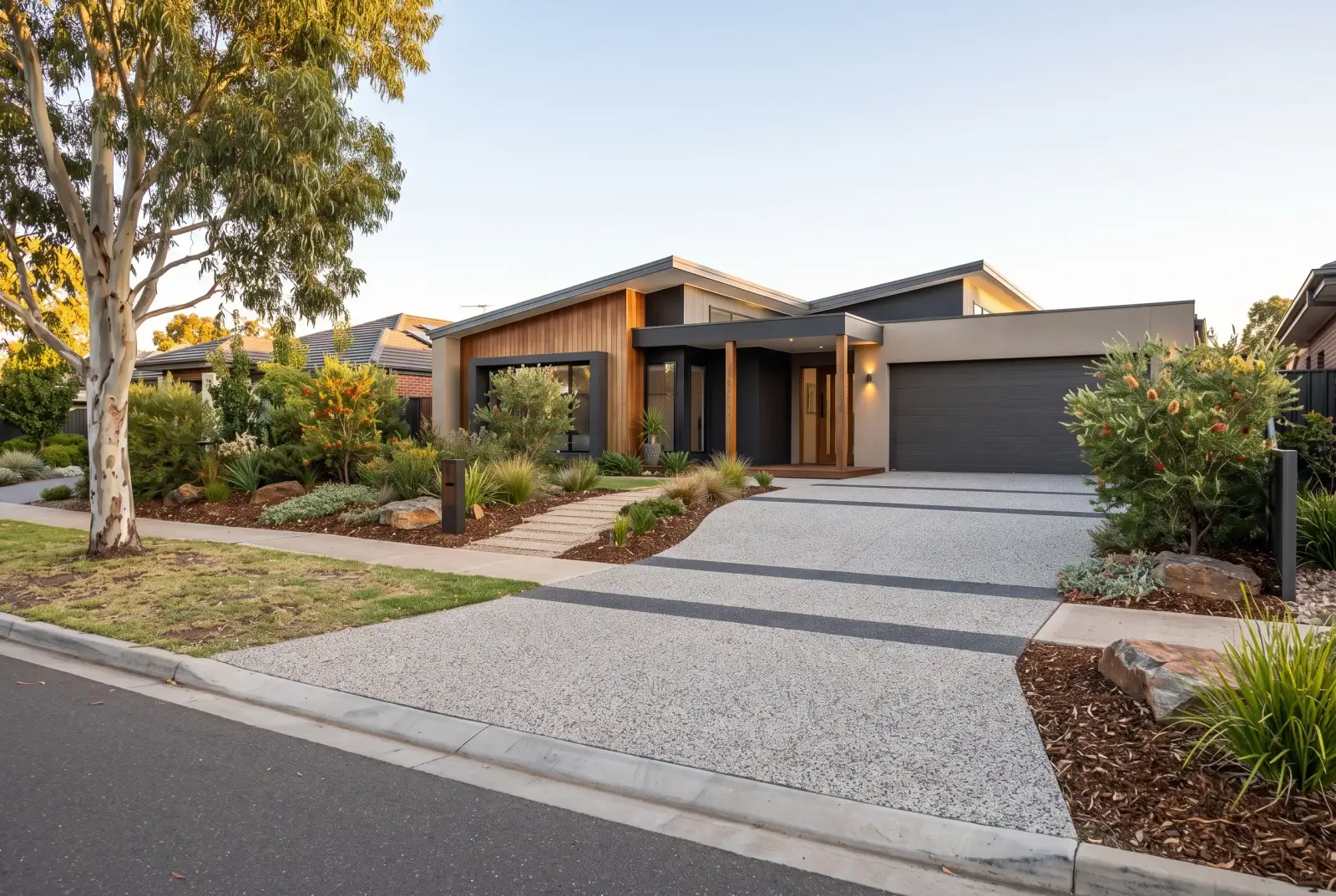
A great concrete driveway does two jobs at once: it looks the part out the front of your home, and it stands up to cars, sun and weather for decades. After 25 years pouring driveways across the Adelaide Hills, Mount Barker and beyond, we have learned that the best-looking driveways are also the most practical ones. Here are the design ideas that work in South Australia — and the practical notes that keep good looks from becoming a headache.
Start with the finish — it sets the whole look
The single biggest design decision is the surface finish, because it determines the texture, colour and personality of the driveway more than anything else. Concrete is far more versatile than the grey slab most people picture, and each finish gives a distinct look.
- Plain or broom finish: the classic, cost-effective choice. A broomed surface adds fine texture for grip and hides minor marks. Honest, tidy and timeless — and easy to dress up with a coloured border.
- Coloured / oxide concrete: colour mixed right through the concrete (or applied as a topping) for a richer, warmer look than plain grey. Charcoals, tans and sandstones are the SA favourites.
- Stencilled concrete: a pattern (brick, cobble, tile) is stencilled into coloured concrete to mimic pavers at a lower cost and with no joints to weed. Great for a traditional or heritage-style home.
- Stamped concrete: the surface is imprinted with a textured mat to replicate stone, timber or pavers in three dimensions. More depth than stencil, with a premium feel.
- Exposed aggregate: the top layer of cement is washed back to reveal the decorative stone within, giving a hard-wearing, naturally grippy, high-end finish. One of the most popular choices for new SA homes — see our exposed aggregate service for the look.
If you are still weighing up which way to go, our guide on choosing a driveway finish in the Adelaide Hills walks through the trade-offs finish by finish.
Colours that suit South Australian homes
The colours that work best here are the earthy, natural tones — charcoal, sandstone and tan — because they sit comfortably against our local stone, brick and rendered facades. Bright or unusual colours date quickly and fight with the house; the proven palette is restrained and grounded.
- Charcoal and slate greys: modern, dramatic and a brilliant match for contemporary builds with black window frames and timber accents. Charcoal also disguises tyre marks and general grime better than almost anything else.
- Sandstone and buff: soft, warm and a natural fit for heritage homes, render and the honey-coloured stone you see right through the Hills and Mid North.
- Tan and earthy browns: warm and welcoming, and forgiving of the red dust that blows around on rural and Riverland blocks.
Colour can be achieved through oxides mixed through the concrete, surface hardeners, or dyes and stains. For the full rundown on how each method behaves over time, see our coloured concrete options for SA homes guide before you lock in a shade.
Banding, borders and feature strips
A contrasting border or band is the easiest way to lift a driveway from plain to designed, and it costs surprisingly little. A simple charcoal border around a sandstone field, or a strip of exposed aggregate framing a broomed surface, instantly reads as intentional and finished rather than just a slab of concrete.
Ideas that work well:
- Perimeter borders: a contrasting band running around the edge of the driveway, tying it to paths and garden edges.
- Feature strips: bands set across the driveway at intervals to break up a long run and add rhythm — these can double as expansion or control joints.
- Edge framing: a coloured or exposed-aggregate edge against a plain field, which sharpens the whole shape.
Because feature strips can be aligned with the joints the driveway needs anyway, you often get the look for very little extra — the joint has to go somewhere, so you might as well make it a design feature.
Combining finishes for a custom look
Mixing two finishes is where driveways start to look genuinely bespoke — an exposed aggregate field with crisp charcoal bands is a combination we pour a lot, and it never dates. The contrast of textures (smooth band against stony field, or vice versa) does as much work as colour, and it lets you spend on a premium finish where it shows while keeping the bulk of the area sensible.
Popular combinations include:
- Exposed aggregate field with charcoal coloured bands — texture plus a clean dark frame.
- Coloured concrete with an exposed aggregate border — a warm, even field edged with decorative stone.
- Broom-finished main area with a stencilled or stamped feature apron at the entrance, putting the detail where the eye lands first.
Patterns and jointing as a design feature
Every concrete driveway needs control joints to manage cracking, so the smart move is to treat those joints as part of the design rather than something to hide. Joints placed on a considered grid — square panels, or rectangles that echo the proportions of the house — turn a structural necessity into a deliberate pattern. Diamond layouts, oversized panels and joints that line up with the garage door or front steps all read as design, not accident.
This matters for durability as well as looks. Joints are where you want the concrete to crack, so getting their spacing and depth right is what keeps random cracks out of the field. Our guide on why concrete cracks and how we prevent it explains how good jointing protects the finish you have paid for.
Match the driveway to paths, alfresco and the facade
A driveway looks best when it is part of a connected scheme — when the paths, alfresco, steps and the home's facade all speak the same language of colour and finish. A standalone driveway that ignores everything around it always looks a bit lost, no matter how good the finish.
Some ways to pull it together:
- Carry the colour through: use the same charcoal or sandstone tone on the driveway, the front path and the alfresco so the eye reads it as one project. Our concrete footpaths can be matched to the driveway finish exactly.
- Echo the facade: pick up a tone from the brick, render or stone of the house, or contrast deliberately (charcoal driveway against a light render is a strong, modern look).
- Coordinate the steps: front steps and landings in a matching finish complete the entrance — see concrete steps, stairs and landings for how these tie in.
This whole-of-property thinking is exactly how we approach a concrete driveway from the first quote — looking at the front of the home as one composition rather than a series of separate slabs.
Kerb appeal and resale value
A well-designed driveway is one of the highest-impact upgrades you can make to the front of a home, because it is large, immediately visible and signals that the property is cared for. A tired, cracked or stained driveway drags down everything around it; a clean, well-finished one lifts the whole street presentation. For a home you might sell one day, that first impression genuinely shows up in buyer interest. If your existing driveway is past its best, our guide on signs your concrete driveway needs replacing will help you judge whether it is time.
Don't let looks sacrifice function
The best-looking driveway is no good if it is slippery, fades badly or shows every mark — so a handful of practical points should steer the design as much as the aesthetics do. This is the part homeowners often overlook, and it is the part we care about most.
- Grip on slopes: on the steep blocks common around Stirling and through the Hills, texture matters. Exposed aggregate and broomed finishes grip well; smooth, high-sheen surfaces can get slick when wet, so they suit flat aprons more than steep drives.
- Heat and colour: very dark colours absorb more heat and can be hot underfoot in a Mount Barker or Riverland summer. Mid-tones balance the modern look with comfort.
- Hiding marks: mid-to-dark colours and textured finishes hide tyre marks, leaf stains and general grime far better than pale, smooth surfaces.
- Maintenance: all decorative finishes benefit from periodic sealing to keep colour rich and resist stains. Build that into your plan from day one.
- Slope, thickness and drainage: the look sits on top of sound engineering. Our guide on driveway thickness, slope and drainage covers the fundamentals that keep a driveway sound for decades.
We pour driveways right across the region, from the Adelaide Hills to Mount Barker and out into the Riverland and Mid North, and the same principle holds everywhere: design for the block and the climate, not just the photo.
What it costs
Driveway pricing depends heavily on the finish, the size and shape, site access and any prep or drainage works — so a plain broomed driveway and a multi-finish exposed aggregate driveway sit well apart on cost. Rather than guess, it is worth reading our concrete driveway cost guide for SA and, if you are leaning toward stone, the exposed aggregate cost guide. Both give realistic ranges so you can match your design ambitions to your budget before you commit.
Frequently asked questions
What's the most popular driveway finish in SA?
Exposed aggregate is consistently the most popular finish for new South Australian homes, with charcoal-coloured concrete close behind. Exposed aggregate wins on a combination of looks, grip and durability — it suits both modern and traditional homes, handles sloped Hills blocks well, and ages gracefully. Plain broom finishes remain the most common where budget is the priority, and many homeowners get the best of both by combining a broomed or coloured field with an exposed aggregate border or feature strips.
Which concrete colour hides marks best?
Charcoal and mid-to-dark greys hide marks best — tyre scuffs, oil spots, leaf stains and general grime all show far less against a darker, textured surface than they do on pale, smooth concrete. Earthy tans are a good second choice on rural and Riverland blocks where red dust is the main offender, as the warm tone blends with it. The trade-off is heat: very dark colours absorb more sun, so a mid-charcoal is often the sweet spot between hiding marks and staying comfortable underfoot. Texture helps too — any broomed or exposed finish disguises marks better than a smooth one. If you would like advice for your specific block, get in touch and we will talk it through.