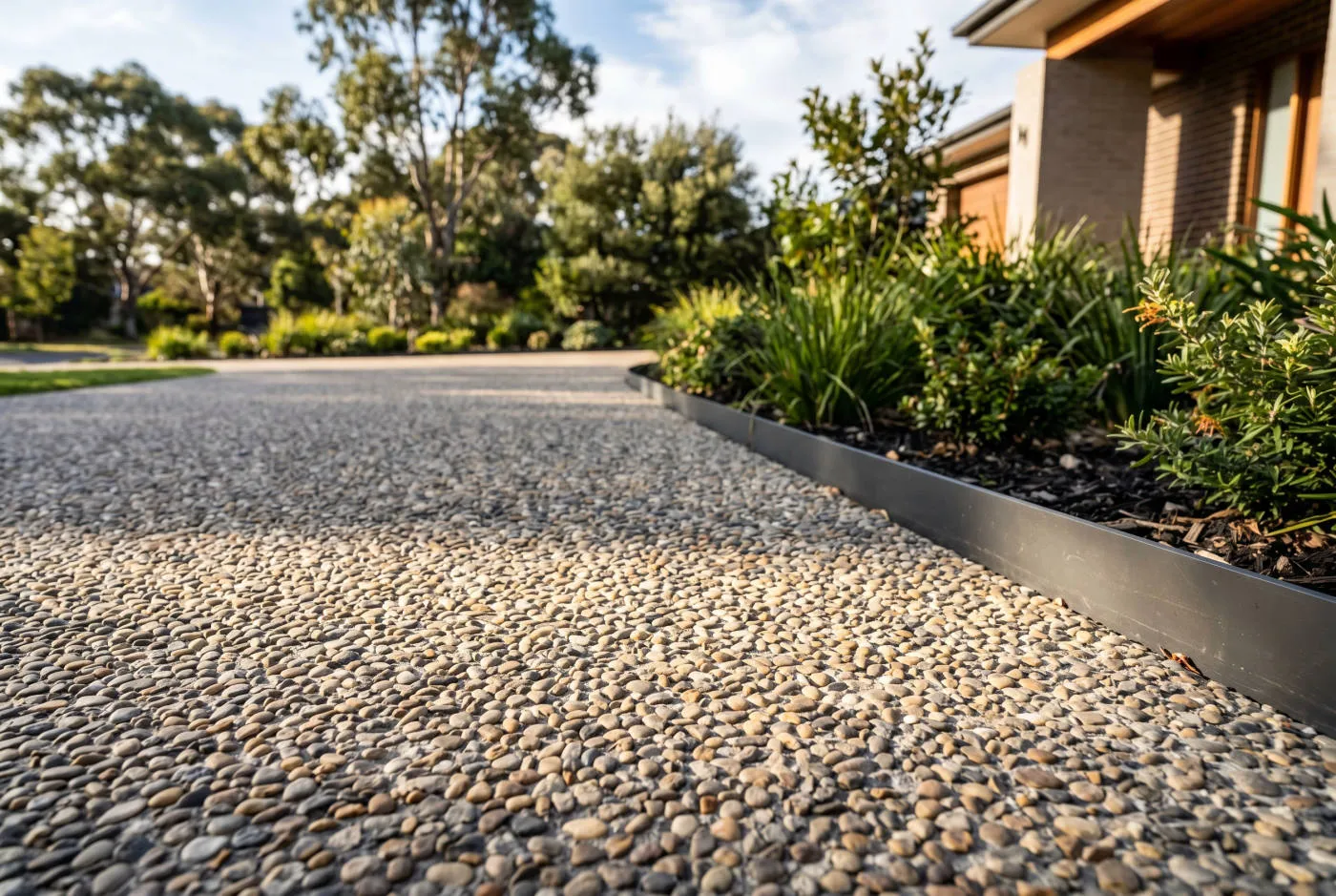
Coloured and decorative concrete has come a long way. Used well, it lets a driveway, path or alfresco area complement the home and landscaping rather than clash with it, often for a modest step up on plain grey. Used poorly, colour can date a property quickly. Here is how the main options compare, and how we help homeowners across the Hills and regional SA choose a finish they will still love in ten years.
Oxide (through-colour) concrete
This is the most common way to colour concrete. A pigment is added so the colour runs all the way through the slab, not just on the surface. The advantage is that minor surface wear or a small chip does not expose a grey patch underneath, because the colour is consistent throughout. Oxide colours tend to be earthy and natural — charcoals, browns, terracottas and sandy tones — which is why they sit so well against stone, brick and the bush backdrop common in the Adelaide Hills. It is a reliable, hard-wearing choice for driveways and large areas.
Dry-shake colour hardeners
A colour hardener is broadcast onto the surface of the fresh slab and worked in. This gives a denser, more wear-resistant surface and richer, more vibrant colour than oxide alone, because the pigment is concentrated at the top. It is often paired with stencil or stamped patterns. Because the colour is on the surface rather than through the slab, the trade-off is that deep damage can show the base concrete, but for the look and surface durability it delivers, it is a popular choice for feature areas.
Stencilled and patterned concrete
Stencilling lays a paper pattern onto the slab before colour is applied, so when it is removed you are left with the look of pavers, brick, cobblestone or tile in a single seamless pour. The appeal is the decorative look of pavers without the joints that weeds grow through and edges that lift over time. Combined with colour, stencilled concrete can closely match a home's brickwork or roof. It works beautifully on driveways, paths and courtyards.
Exposed aggregate
Strictly speaking exposed aggregate is a texture rather than a colour, but it is one of the most popular decorative finishes we pour, and the stone blend gives it plenty of natural colour. Washing back the surface reveals the pebbles and stone in the mix for a textured, high-end look that hides marks and grips well underfoot — a real advantage on the steep, wet blocks common in the Hills. You can choose the stone blend to set the overall tone, from pale and warm to dark and dramatic. See our exposed aggregate page and the cost guide for more.
Where coloured concrete works best
Some areas suit decorative concrete more than others. Driveways are a natural fit, because a coloured or stencilled finish is what most people see first when they arrive at a home, and it ties the entrance in with the house. Alfresco areas, courtyards and pool surrounds are another strong candidate — here the colour and texture set the tone of the outdoor living space, and an exposed aggregate or textured finish adds grip where bare feet and water mix. Paths and perimeter strips can pick up the same colour to carry the look right around the property. For large rural or commercial areas the calculation is different: plain or lightly coloured concrete is usually the practical choice there, with decorative finishes saved for the spaces people actually look at and use day to day. We are happy to advise on where the budget is best spent.
Choosing a colour that lasts
A few practical pointers we share with clients:
- Pull colours from the house, not the trends. Match to your roof, render or brick and the result will still look right in a decade.
- Go easy on very dark colours in full sun — they absorb heat and can be uncomfortable underfoot on a summer day in the Mid North.
- Always view a sample on site, in your own light. Colour looks different in a brochure, in the shade and in full afternoon sun.
- Factor in sealing. Coloured and decorative finishes are sealed to protect them and lift the colour, and re-sealed every few years to keep them looking their best.
Caring for coloured concrete
Decorative finishes ask a little more than plain concrete, but not much. Keep the surface clean, deal with spills reasonably promptly, and re-seal every few years — more often in high-traffic or full-sun areas. Done that way, a coloured driveway holds its colour and finish for the long haul. If you are weighing concrete against the alternatives, our concrete versus pavers comparison is worth a read. When you have an idea of the look you want, get in touch and we will bring samples to your block.
Where coloured concrete works best
Colour isn't just for driveways. It works beautifully on paths, patios, pool surrounds and around entries, letting you tie all the hard surfaces on a property together in one tone. Many homeowners across Mount Barker and the Adelaide Hills pick a colour that complements the roof or render, then carry it through the driveway and paths for a cohesive, considered look. On larger or rural blocks, a coloured finish can also help a big expanse of concrete feel less stark.
Caring for coloured concrete
Coloured concrete keeps its best appearance with a good sealer, which deepens the colour and protects against staining and UV. Re-sealing every few years is a small, easy job that makes a big difference over time. Quality oxide colours are mixed through or applied properly and hold up well in our climate — the main enemies are harsh chemicals and a worn-out seal, both of which are easily managed. We'll let you know the right time to seal after the pour and how to keep it looking sharp.
The main ways to colour concrete
There is more than one way to get colour into a slab, and each has its place. Through-colour (oxide mixed into the concrete) tints the whole batch, so the colour runs all the way through and won't wear off — a robust, popular choice for driveways. Dry-shake colour hardeners are worked into the surface during finishing, giving a denser, more wear-resistant and often richer-coloured top layer, which suits high-traffic areas. Stains and tints are applied to cured concrete and can create mottled, variegated looks. For most home driveways and paths across the Hills, through-colour or a dry-shake hardener gives the best balance of durability and looks, and we'll recommend the right approach for your job.
Choosing a colour that still looks good in ten years
Colour choice is where people most often second-guess themselves, so a few principles help. Earthy, mid-tone greys, charcoals and warm sand tones are the most timeless and the most forgiving of dust, leaf litter and tyre marks — important on a leafy Adelaide Hills block. Very dark colours look striking but get hot underfoot and show efflorescence (a harmless white bloom) more readily; very light colours show stains. It also pays to view samples outdoors on your own block, because colour reads completely differently in daylight against your render, brick and garden than it does on a small chip indoors. We bring samples to every quote for exactly this reason.
Combining colour with other finishes
Coloured concrete doesn't have to stand alone. A popular look is a coloured base with an exposed aggregate border, or coloured concrete with a stencilled pattern that mimics pavers or tiles in a single, joint-free slab. Carrying one colour across the driveway, paths and a patio ties a property together and makes the whole block feel considered rather than piecemeal. These combinations cost a little more in finishing time but can transform the look of a home for far less than re-landscaping.
Common questions about coloured concrete
Will the colour fade? Quality oxide colours hold up well; a maintained sealer protects against UV and keeps them rich. Is coloured concrete more expensive than plain? A little — it's a moderate step up, less than exposed aggregate. What is the white haze on my coloured slab? Usually efflorescence, a natural mineral bloom that fades over time and can be cleaned. Can you match a specific colour? We work from established oxide colour ranges and will get as close as possible to your target — seeing samples on site is the best way to lock it in.