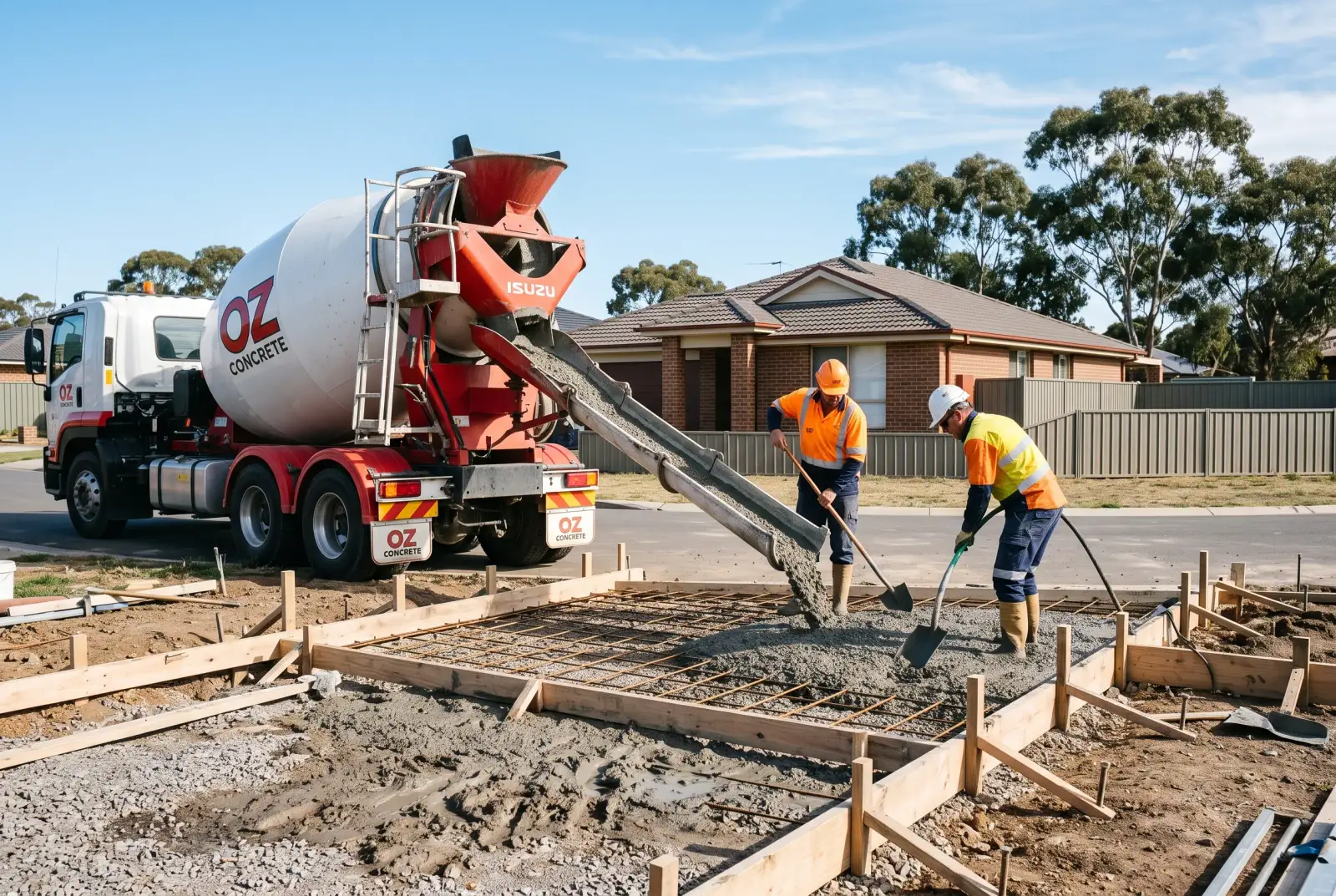
Working out how much concrete you need comes down to one simple sum: length times width times thickness, all measured in metres, gives you the volume in cubic metres. Get that number right and ordering is straightforward; get it wrong and you either run short mid-pour or pay for concrete you tip down the side of the block. After 25 years of pouring slabs and driveways across the Adelaide Hills and beyond, here is exactly how we calculate it, with worked examples you can follow at home.
The basic formula for concrete volume
To find concrete volume, multiply length (m) by width (m) by thickness (m) — the answer is in cubic metres, which is how ready-mix concrete is ordered and priced. Concrete is always sold by the cubic metre (often shortened to "cube" on site), so your goal is to turn the dimensions of your slab or driveway into that single figure.
The one trap people fall into is mixing up their units. Thickness is nearly always quoted in millimetres, so you must convert it to metres before you multiply. A 100mm slab is 0.1m thick; a 125mm slab is 0.125m; a 150mm slab is 0.15m. So the full formula is:
- Volume (m³) = length (m) × width (m) × thickness (m)
- Example: a slab 6m long, 4m wide and 100mm thick = 6 × 4 × 0.1 = 2.4 cubic metres
That is the whole calculation. Everything else is about getting your measurements honest and adding a sensible allowance for the real world.
Worked examples: driveways, slabs and paths
Here are four common jobs worked through end to end so you can see how the numbers stack up. These use typical thicknesses — but thickness depends on what the concrete carries and the ground it sits on, which we cover further down.
Single driveway
A standard single driveway is roughly 3m wide. Say yours runs 12m from the road to the garage:
- 12m × 3m × 0.1m (100mm) = 3.6 cubic metres
- At 125mm for a bit more durability: 12 × 3 × 0.125 = 4.5 cubic metres
Double driveway
A double driveway is around 6m wide. Over the same 12m length:
- 12m × 6m × 0.1m = 7.2 cubic metres
- At 125mm: 12 × 6 × 0.125 = 9 cubic metres
Shed or garage slab
A common shed slab is 6m × 9m. Shed and house slabs are usually thicker than a path because they carry heavier loads and need edge thickenings:
- 6m × 9m × 0.1m = 5.4 cubic metres for the flat area alone
- Add the thickened edge beams and that figure climbs — which is one reason slab volumes are easy to underestimate
Garden path or footpath
A path 15m long and 1m wide at 75mm thick:
- 15m × 1m × 0.075m = 1.125 cubic metres
If your area is an awkward shape, break it into rectangles, work out each one, then add them together. For a triangle, calculate it as half of the rectangle it would fit inside.
A quick reference for common driveway lengths
Most Hills driveways fall into a predictable range, so it helps to see how the numbers move as the run gets longer. These all assume a single-width 3m driveway at 125mm, which is a sensible default for cars on a reasonable base:
- 8m long: 8 × 3 × 0.125 = 3 cubic metres
- 15m long: 15 × 3 × 0.125 = 5.6 cubic metres
- 20m long: 20 × 3 × 0.125 = 7.5 cubic metres
- 30m long (common on rural blocks): 30 × 3 × 0.125 = 11.25 cubic metres
You can see how quickly the figure climbs on the longer rural runs we often pour out past Nairne and toward the Murray. A small error in your width or thickness estimate on a 30m driveway is a much bigger error in cubic metres than the same slip on a short suburban drive, which is exactly why long runs are the easiest to under-order.
Why you add a waste and spillage allowance
Always order around 5–10% more than the bare calculation, because a real pour never matches the textbook number exactly. The ground is never perfectly flat, some concrete sticks in the truck and the wheelbarrows, a little spills at the edges, and form boards bow slightly under the weight of wet concrete. Order to the exact litre and you risk coming up short with the truck halfway emptied.
The bigger reason on a Hills block is over-excavation. When you dig out for a slab, the base is rarely level to the millimetre. Any low spots, soft patches you have dug out, or a base that has been compacted unevenly all swallow extra concrete. A driveway running across a slope eats more again where it fills hollows. We allow more on rough rural ground than on a tidy, machine-prepared suburban pad — see how a clean base is built in our guide on how to prepare for a concrete pour.
How thickness changes the volume — and the strength
Thickness has a direct, linear effect on volume: going from 100mm to 150mm increases the concrete you need by 50%. That is a big jump in both material and cost, so the right thickness is not a number to guess at. It is set by what the concrete has to carry and how good the ground underneath is.
- Paths and light foot traffic: often 75–100mm
- Residential driveways (cars): typically 100–125mm
- Driveways with heavier vehicles, trailers or boats: 125–150mm
- Shed and house slabs: engineered to the soil and load, with thickened edge beams
Slope and drainage also feed into the design — a steep Hills driveway needs careful thickness and fall so water runs off rather than pooling. We go through all of this in our guide on driveway thickness, slope and drainage. Getting thickness right is also one of the main ways we stop cracking down the track, which we explain in why concrete cracks and how we prevent it.
Ordering by the cubic metre — and why getting it wrong is costly
Ready-mix concrete is batched and delivered by the cubic metre, and ordering slightly wrong costs real money in two ways. Order too much and you pay for concrete that ends up dumped. Order too little and you hit two problems that are worse than wasted material.
- Short-load and extra delivery fees: if you run out and have to call a second, small load, you typically pay a short-load surcharge on top of the concrete, because the batching plant and truck still have to make the trip.
- Cold joints: if there is a long gap while you wait for more concrete, the first pour starts to set before the second arrives. The two never bond properly, leaving a weak line — a cold joint — that can crack and let water in. On a driveway or slab that is a permanent fault, not a cosmetic one.
This is the heart of why volume matters. A few hundred extra litres in the order is cheap insurance against a cold joint or a second delivery fee. To understand why a continuous, properly-bonded pour matters so much, it helps to know what concrete is actually made of and how it gains its strength.
Why we measure and order it for you
On any job we quote, we measure the area, set the right thickness for the load and the ground, allow for the base and the edges, and place the concrete order ourselves. That takes the guesswork off your plate and puts the responsibility for getting the volume right where it belongs — with the people pouring it.
It also means the order matches the design. The thickness on a concrete driveway is chosen for the vehicles and the fall of your block, and the volume for a shed or house slab includes the thickened edges and any internal beams the engineering calls for. For a rough idea of budget before we visit, our concrete driveway cost guide for SA sets out what drives the price. We do this work right across the region, from the Adelaide Hills through to the Mid North and Riverland.
Frequently asked questions
How many bags of concrete are in a cubic metre?
Roughly 108 to 110 standard 20kg bags of pre-mixed concrete make up one cubic metre. That is a lot of bags, a lot of mixing and a high risk of cold joints between batches — which is exactly why anything bigger than a small repair or a couple of fence posts is far better poured from a ready-mix truck. Bags suit tiny jobs; cubic metres suit driveways and slabs.
How much concrete do I need for a single driveway?
As a rough guide, a single driveway about 3m wide and 12m long at 100mm thick needs around 3.6 cubic metres, or about 4.5 cubic metres at 125mm. Your exact figure depends on the real length, width and the thickness we set for your block, plus the waste allowance — so treat this as a ballpark, not a quote.
How do I work out concrete for an odd-shaped area?
Break the area into simple rectangles and triangles, calculate each piece on its own (length × width × thickness in metres), then add them together. Round up rather than down, and remember to add the 5–10% allowance to the total once you have it.
Can I just order a bit extra to be safe?
A modest allowance of 5–10% is sensible and standard. Ordering far more than that simply means paying for concrete you will tip out, since you usually cannot return what the truck delivers. The aim is a tidy margin, not a big surplus — another reason to let us calculate the exact figure for your job. If you would rather we measured it up, just get in touch through our contact page.