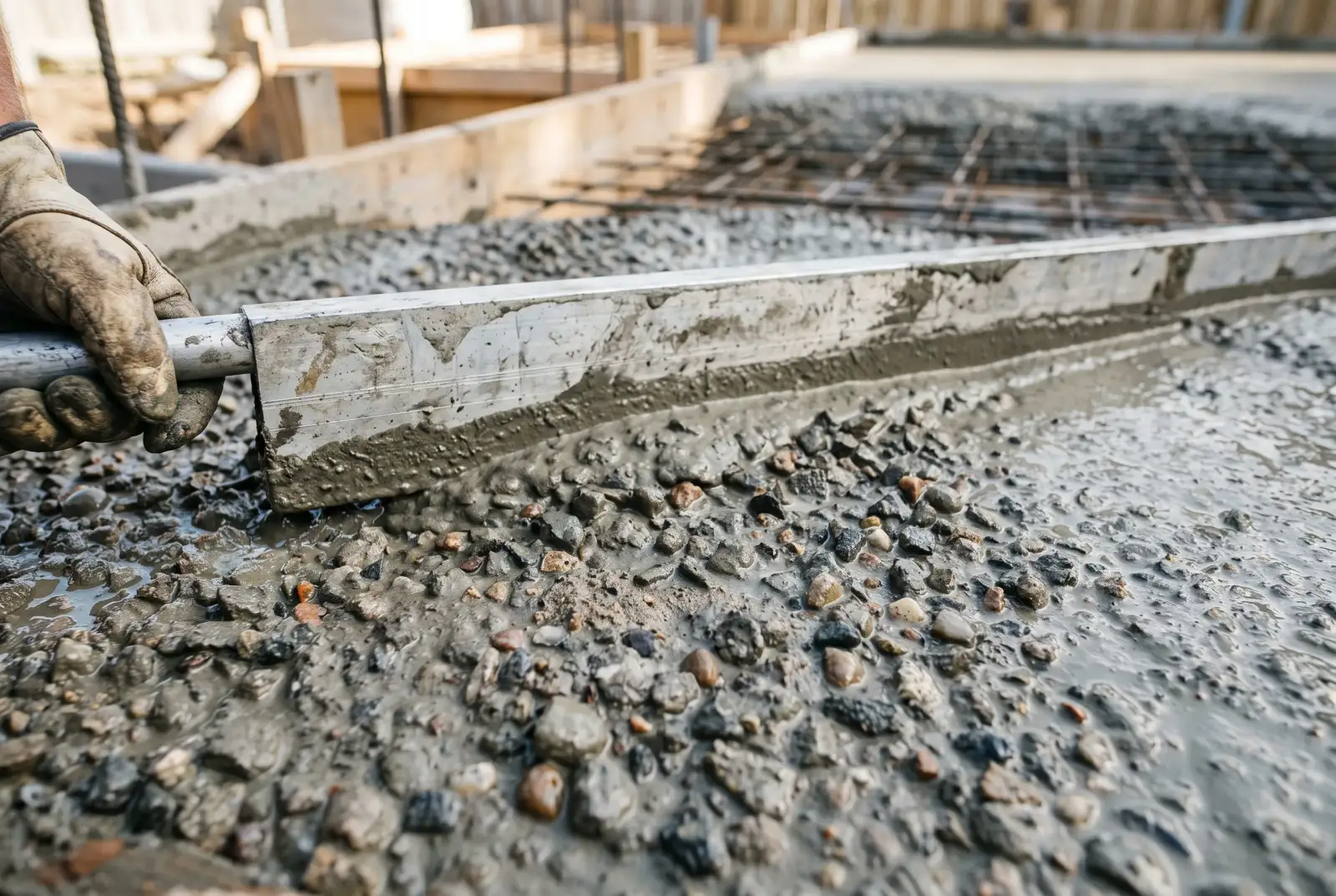
Concrete is one of the most-used building materials on earth, yet most people are fuzzy on what is actually in it. The short answer: concrete is a mix of cement, aggregate (stone), sand and water, and the proportions of each — along with the strength grade and the slump — decide how it performs once it sets. Here is a plain-English breakdown of the ingredients, the jargon you will hear on a quote, and why each part matters for a driveway or slab that lasts.
The four ingredients in concrete
Concrete is made from four basic ingredients — cement, coarse aggregate, sand and water — and each one does a specific job. Change the balance and you change the strength, the workability and the durability of the finished surface.
- Cement is the glue. It is a fine grey powder that, once mixed with water, undergoes a chemical reaction (hydration) and hardens, binding everything else together. Cement is only part of the recipe — it is not concrete on its own.
- Coarse aggregate is the crushed stone or gravel. It makes up the bulk of the volume and gives concrete its strength and stability. Bigger, well-graded stone means a stronger, more economical mix.
- Sand (fine aggregate) fills the gaps between the larger stones, helping the mix knit together tightly with fewer voids.
- Water triggers the hydration reaction and makes the mix workable enough to place and finish. As we will see, the amount of water is one of the most important decisions in the whole mix.
Concrete versus cement — they are not the same thing
Cement and concrete are not interchangeable: cement is one ingredient, and concrete is the finished material you pour. People say "cement driveway" all the time, but technically you are pouring a concrete driveway in which cement is the binder. Think of it like a cake — cement is the flour, and concrete is the cake. You would never call a cake a "flour."
This matters because cement on its own is weak and prone to shrinking and cracking. It needs the aggregate and sand to give it body and strength. That is why a proper concrete driveway is far more durable than anything made from a cement-heavy, stone-light mix.
What MPa and strength grades mean
MPa stands for megapascals, and it is the measure of compressive strength — how much load the hardened concrete can carry before it crushes. When you see a grade like N20, N25 or N32, the number is the strength in MPa at 28 days, which is the standard age at which concrete is tested. Higher number, stronger concrete.
- N20 (20 MPa): a basic mix, suitable for light-duty applications like some paths and non-structural fill.
- N25 (25 MPa): a common choice for residential driveways, footpaths and many domestic slabs.
- N32 (32 MPa): a stronger structural mix used for house slabs, heavier-duty driveways and commercial work where loads are higher.
The right grade depends on the job. A garden footpath does not need the same strength as a house or shed slab that carries walls and machinery. We specify the grade to suit the load and the conditions, rather than defaulting to the cheapest mix. The same thinking applies to thickness — the two work together, which is why we set both based on your block in our guide on driveway thickness, slope and drainage.
What slump is and why it matters
Slump is a measure of how wet and workable the concrete is — literally how far a cone-shaped sample slumps down when the mould is lifted. A low slump means a stiff, dry mix; a high slump means a wetter, more flowable mix. It is measured in millimetres and quoted on the docket when the truck arrives.
Slump matters because it has to suit the job. A driveway on a slope needs a firmer mix that will not run downhill before it is finished, while concrete being pumped a long distance or placed in a tricky spot may need to flow more freely. The temptation is always to ask for a wetter mix because it is easier to spread — but adding water to gain workability comes at a serious cost, which brings us to the next point.
Why the water-cement ratio is so important
The water-cement ratio — the amount of water relative to cement — is the single biggest factor in how strong and durable concrete ends up. Too much water weakens the finished product. It might be easier to place on the day, but as the excess water evaporates it leaves tiny voids, producing concrete that is weaker, more porous, dustier on the surface and far more prone to cracking and surface flaking.
This is why a good crew resists the urge to "water it up" on site. We get workability from the mix design and admixtures, not by hosing extra water into the truck. A controlled water-cement ratio is one of the foundations of crack resistance, alongside good base prep, reinforcement and joints — all of which we cover in why concrete cracks and how we prevent it. It also affects curing: well-mixed concrete that is kept damp while it sets gains far more of its potential strength, as we explain in how long concrete takes to cure and dry.
Admixtures, fibre and reinforcement
Beyond the four core ingredients, modern concrete often includes admixtures and reinforcement to improve how it performs. These are not gimmicks — they solve real problems on real jobs.
- Admixtures are small additions that change the behaviour of the mix. Plasticisers improve workability without adding water; retarders slow the set on a hot Hills day; accelerators speed it up in cold weather; air-entraining agents help concrete resist frost.
- Fibre — fine polypropylene or steel fibres mixed through the concrete — helps control the fine shrinkage cracking that occurs as concrete cures. It is dispersed throughout the whole pour rather than sitting at one level.
- Reinforcement is separate from the mix itself. Steel mesh or reinforcing bar is laid into the slab before the pour to handle tensile (pulling) loads that the concrete alone cannot. Concrete is very strong in compression but weak in tension, so the steel does the pulling work while the concrete does the squeezing work.
It is worth being clear that fibre and steel reinforcement do different jobs. Fibre helps with early shrinkage cracking through the body of the slab; mesh and bar provide structural strength and tie the slab together. On most driveways and slabs we use the reinforcement the design calls for, and add fibre where it helps.
One thing reinforcement does not do is replace good base preparation or properly cut joints. Steel positioned in the wrong part of the slab — sitting on the ground rather than held up on bar chairs at the correct height — does very little, which is why placement matters as much as the steel itself. We set mesh on chairs so it sits in the structurally useful zone, then place and finish the concrete around it. Combine that with the right grade, a controlled water-cement ratio and well-timed joints, and you have a slab that resists both load and cracking for decades rather than years.
Ready-mix versus site-mix concrete
For driveways and slabs, ready-mix concrete delivered by truck is almost always the right choice over mixing on site. Ready-mix is batched at a plant to a precise recipe — exact grade, exact slump, controlled water-cement ratio — and delivered in a continuous load so the whole pour goes down together. That consistency is hard to match with bags and a site mixer.
Site-mixing from bags has its place for very small jobs — a couple of fence posts or a small repair — but for anything substantial it introduces two big risks: inconsistent strength between batches, and cold joints where one batch sets before the next is mixed. If you want to understand how much concrete a job actually needs (and why ordering the right volume avoids those joints), see our guide on how much concrete you need. We pour ready-mix on jobs right across the Mount Barker district and the wider region.
Frequently asked questions
What MPa is residential concrete?
Most residential concrete falls between 20 and 32 MPa. Paths and light-duty areas are often around N20–N25, standard driveways commonly use N25, and house slabs and heavier-duty work step up to N32. The right grade depends on the load and the soil, which is why we specify it per job rather than using a one-size-fits-all mix.
Is cement the same as concrete?
No. Cement is a single ingredient — the fine powder that acts as the binder — while concrete is the finished material made by combining cement with aggregate, sand and water. When people say "cement driveway" they almost always mean a concrete driveway.
Does more cement make concrete stronger?
Up to a point, but it is not that simple. Strength comes from the whole mix design working together — the right cement content, well-graded aggregate, and crucially a controlled water-cement ratio. Too much water will weaken even a cement-rich mix, and too much cement alone can actually increase shrinkage cracking. Balance beats brute force.
What is the strongest part of a concrete slab?
Concrete is strongest in compression — squeezing loads — which is why it carries weight so well. It is comparatively weak in tension, so steel mesh or bar is added to handle the pulling forces, especially around edges, openings and where the slab spans soft ground. The combination of strong concrete and well-placed steel is what makes a slab durable. If you are weighing up a slab or driveway, the team is happy to talk it through via our contact page.