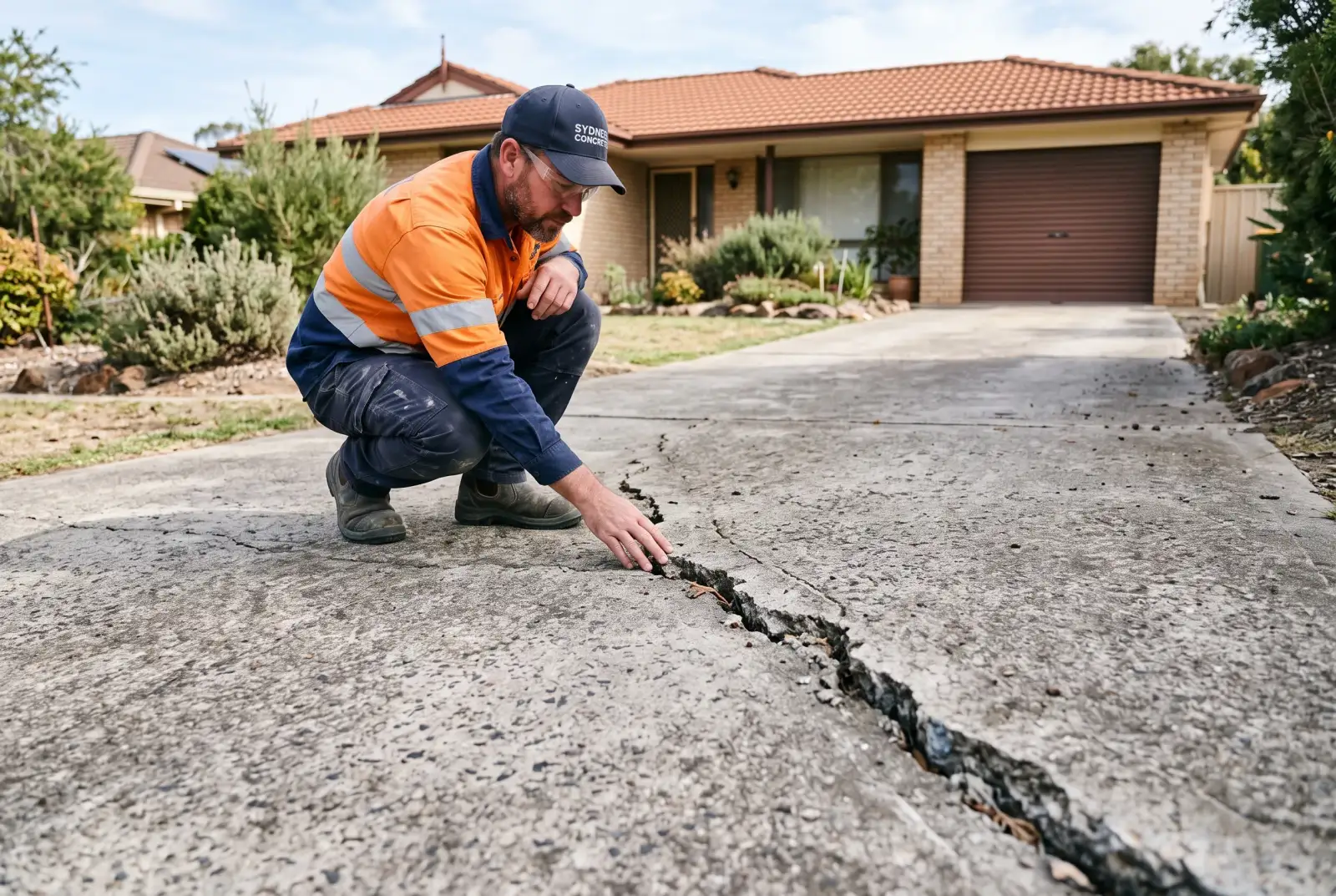
Nearly every concrete slab and driveway will crack at some point — the real question is whether the crack you are looking at is a cosmetic nuisance or a sign that the slab is failing. After 25 years pouring and repairing concrete across the Adelaide Hills, Mount Barker district, the Riverland and the Mid North, we have learned that knowing which cracks to ignore, which to seal, and which mean the slab needs replacing will save you a lot of money and worry.
How do you tell a cosmetic crack from a serious one?
The quickest test is to look at width, movement and whether the two sides of the crack still line up. Cosmetic cracks are narrow, stable and level. Serious cracks are wide, growing, or have one side sitting higher than the other. Here is how the common types break down.
Hairline cracks and crazing (usually cosmetic)
Hairline cracks are thin surface lines, often less than a millimetre wide. Crazing is a fine network of shallow cracks that looks a bit like cracked glass or a dry creek bed. Both are almost always surface-only and come from the top layer drying and shrinking faster than the concrete underneath. They do not affect the strength of the slab and rarely need anything more than a seal to keep water and dirt out. They are extremely common and nothing to lose sleep over.
Shrinkage cracks (usually cosmetic, sometimes worth sealing)
As fresh concrete cures it shrinks slightly, and if that shrinkage is not controlled by saw-cut or tooled joints it relieves itself as a crack. These run in roughly straight lines and are typically a couple of millimetres wide. They are not a structural problem, but they are an entry point for water — and in our reactive-clay country, water getting under a slab is what causes the bigger trouble. Sealing them is sensible.
Settlement and heave cracks (often serious)
These are the ones to take seriously. If one side of a crack has dropped or lifted so the surface no longer sits flush, the ground beneath the slab has moved. In the Hills and Mid North that is usually reactive clay swelling when it is wet and shrinking when it is dry, or a base that was never compacted properly. A slab that is rocking, stepping or tilting is telling you the foundation is the problem, not just the concrete.
Structural cracks (serious)
Wide cracks (say 5 mm or more), cracks that run right across a slab or through its full depth, cracks that keep widening, and any cracking paired with crumbling or flaking edges point to a structural issue — undersized concrete, missing or rusting reinforcement, overloading, or a failed base. These are not a patch-and-forget situation. To understand the mechanisms behind all of this, our explainer on why concrete cracks and how we prevent it is worth a read.
Why does concrete crack in the first place?
Most cracking comes down to three things: the ground, the base and the joints. Get those right and you avoid the majority of serious cracks. Get them wrong and no amount of repair will hold for long.
- Reactive clay soils. Much of the Adelaide Hills and the Mid North sits on clay that expands when wet and contracts when dry. That seasonal movement puts enormous stress on anything sitting on top of it. Slabs poured without allowance for this movement crack and lift.
- Poor or uncompacted base. Concrete is only as good as what it sits on. A base that was not properly excavated, levelled and compacted will settle unevenly, and the slab cracks to follow it. Good earthmoving and site preparation is the single biggest factor in a slab that lasts.
- No control joints, or joints in the wrong place. Control joints give shrinkage a planned place to crack. Leave them out, space them too far apart, or cut them too shallow and the slab decides where to crack on its own.
- Inadequate thickness or reinforcement. A driveway that has to carry vehicles needs the right depth and steel. Skimp on either and cracking is only a matter of time. Our guide to driveway thickness, slope and drainage covers what the slab actually needs.
This matters for the repair-or-replace decision, because if the underlying cause is still there, any repair is temporary by definition.
DIY crack fillers — and where they fall short
For narrow, stable, cosmetic cracks, a DIY filler is a perfectly reasonable first move. The hardware-store products fall into a few groups:
- Flexible polyurethane or polymer sealants in a caulking gun — good for sealing hairline and shrinkage cracks against water, and they flex a little with the slab.
- Cement-based crack fillers and patching compounds — better for slightly wider cracks but rigid, so they tend to re-crack if there is any movement.
- Epoxy fillers — strong and hard, but unforgiving of movement, so best on cracks that are genuinely dead.
The honest limits of DIY: a filler hides a crack, it does not fix the cause. If the slab is still moving on reactive clay, or the base is still settling, the filler will crack again or the patch will pop out within a season or two. DIY also struggles to colour-match decorative finishes, so on exposed aggregate or coloured concrete a clumsy patch can look worse than the crack. And no tube of filler will re-level a slab that has sunk. Knowing those limits keeps you from throwing good money after bad.
Professional repair options
When a crack is past the DIY stage but the slab is fundamentally sound, there are several professional repairs that genuinely extend the life of the concrete.
Rout and seal
We widen the crack slightly into a clean channel, clean it out, and fill it with a flexible, high-quality sealant designed to move with the slab. This is the proper way to deal with an active but non-structural crack — it keeps water out and accommodates seasonal movement far better than a surface smear of filler.
Resurfacing or an overlay
If the slab is structurally sound but the surface is tired, crazed or stained, a polymer-modified overlay can give it a fresh, uniform top. Resurfacing only works when what is underneath is stable — it is a cosmetic fix laid over a healthy slab, not a cure for movement. If you are weighing up a refresh, it pairs well with proper cleaning first; see our notes on how to clean concrete and remove stains.
Slab jacking and re-levelling
When a slab has sunk but is otherwise in one piece, it can sometimes be lifted back to level by pumping grout or a structural resin beneath it to fill the void and raise it. This is far cheaper than replacement and ideal for a section of footpath or driveway that has settled over a soft spot. It does not work if the concrete itself is broken into pieces — there has to be a solid slab to lift.
When repair is throwing good money after bad
The line we draw is this: repair when the slab is sound and the cause is stable; replace when the slab is failing or the base is the real problem. Replacement on a properly corrected base is often the cheaper option over ten years, even though it costs more up front. Consider replacing when:
- The slab is cracked into multiple moving pieces, or cracks are wide and still growing.
- Sections are stepping, rocking or tilting — a clear sign the ground beneath has failed.
- The concrete is spalling, crumbling at the edges, or the reinforcement is exposed and rusting.
- You have already patched the same area more than once and it keeps coming back.
- The original slab was too thin or laid on a poor base — repairs will never outlast the underlying fault.
The key point with replacement is that the new slab must go down on a corrected base. There is no sense pouring fresh concrete onto the same reactive, uncompacted ground that wrecked the first one. That is where proper excavation, fill and compaction earn their keep, and it is exactly what we plan for on every new concrete driveway we pour. If you are seeing several of the warning signs above, our checklist on the signs your concrete driveway needs replacing will help you make the call.
Getting an honest assessment
You cannot always judge a crack from a photo, because the important detail is movement, depth and what is happening to the base. A good concreter will get down and look at the width, run a finger across to feel for a step, check whether the slab moves underfoot, and ask how the crack has changed over time. The honest answer is sometimes "leave it, it is only cosmetic" — and we say that often. Where we serve, from the Adelaide Hills through Mount Barker and out to the Riverland and Mid North, reactive clay is the usual culprit, so the assessment is as much about the ground as the concrete. If you would like a look over a crack you are unsure about, get in touch through our contact page and we will give you a straight answer.
Frequently asked questions
Are hairline cracks a problem?
Almost never. Hairline cracks and crazing are surface-only and come from the top layer drying faster than the concrete beneath. They do not weaken the slab. The only thing worth doing is sealing them so water and grime cannot get in — particularly useful on driveways sitting on reactive clay, where keeping water out of the base is half the battle. If a "hairline" crack is widening, stepping or letting water through, then it is no longer hairline and deserves a proper look.
Can you repair a cracked driveway, or does it have to be replaced?
It depends entirely on what is causing the crack. If the slab is sound and stable, a cracked driveway can usually be repaired with rout-and-seal, resurfacing or re-levelling, and that will buy you many more years. If the slab is broken into moving pieces, stepping, spalling, or the base beneath it has failed, repair is a short-term patch and replacement on a corrected base is the real fix. The deciding factors are crack width, whether it is still moving, and whether the ground underneath is the problem. An on-site assessment is the only reliable way to know which camp your driveway falls into.
Will sealing a crack stop it spreading?
Sealing keeps water out and slows water-related damage, which is genuinely worthwhile, but it will not stop a crack that is being driven by ground movement or a failing base. A flexible rout-and-seal repair can accommodate small seasonal movement; it cannot hold back a slab that is settling or heaving. If a crack keeps coming back after sealing, treat that as a sign the cause needs addressing rather than the symptom.