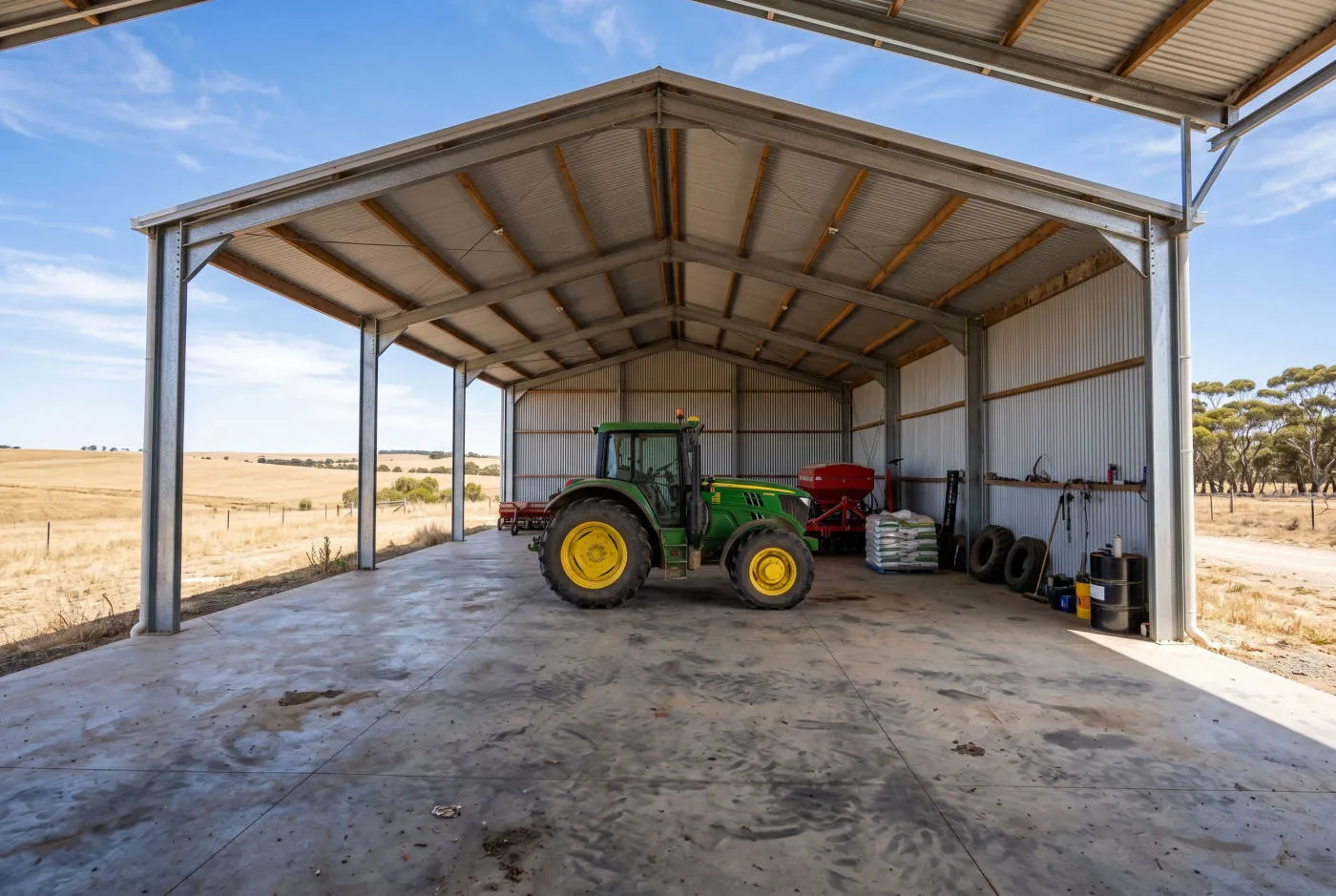
A farm shed slab is a different animal to a suburban garage floor. It might carry a tractor, a loaded grain auger, a ute and trailer, hay stacked to the rafters, or a workshop full of heavy gear — sometimes all at once. Get the slab right and it will serve the property for decades. Get it wrong and you are left with a cracked, dusty floor that is expensive to fix once the shed is up. After 25 years pouring rural slabs around Morgan, the Mid North and beyond, here is what we tell people to think through first.
Work out the real load first
The single most important question is what is actually going to sit and move on the slab. A slab for a domestic toy shed is worlds apart from one that takes a loaded tractor or a forklift. Point loads from machinery jacks, posts and racking matter as much as the overall weight, and they drive the thickness and the reinforcement. It is always cheaper to build for the real use up front than to discover the floor cannot take it later. Tell us honestly what the shed is for and what the heaviest thing on it will be, and we will spec the slab to suit.
Thickness and reinforcement
Heavier use means a thicker slab and more steel. A working machinery or implement floor needs considerably more than a domestic garage, and the reinforcement has to be sized and placed correctly — chaired up off the base so it sits in the part of the slab that carries load, not lying on the ground doing nothing. For the heaviest applications, dowelled joints and engineered designs come into play. We match the build to the job rather than pouring everything to the same recipe. Our rural concreting page covers the kinds of slabs we pour for working properties.
The base is everything on rural ground
Rural sites are often on fill, sloping ground, or reactive soils that move with the seasons — and the slab is only as good as what sits beneath it. A poorly prepared base will settle unevenly and crack the slab no matter how much steel is in it. Proper preparation means stripping the topsoil, cutting to level, and building and compacting a stable base. Because we do our own earthmoving and site prep, the pad is prepared and the slab is poured by the same crew, so there is no gap between two contractors blaming each other if something is not right.
Drainage and falls
Water is the enemy of a shed floor. You want the surface to shed water and wash-down rather than pond on it, and you want run-off and rain directed away from the slab edges so it does not undermine the base or wet the reactive soil underneath. We set falls to a drain or a doorway, and on sloping rural blocks we think about where the water goes in a heavy storm. Getting this right keeps the floor dry, safe and structurally sound. The same principles we apply to driveway slope and drainage apply here.
Access for the trucks
Rural pours often happen at the end of a long, soft or steep track, and a fully loaded agitator truck is heavy. It is worth thinking about access early: can the trucks get to the slab, is the ground firm enough, and do we need to pump the concrete in? We plan all of this before pour day so there are no surprises. Tell us about the access route, gates, soft ground and any overhead lines when we come out to measure.
Plan for the future
A few things worth deciding before the pour, because they are far harder to change after:
- Conduits and plumbing for power, water or compressed air, set into the slab before it goes down.
- Apron slabs and hardstand outside the doors so machinery is not running off concrete onto mud.
- Future expansion — if the shed might grow, it is worth talking about how the slab could extend.
- Finish — a slip-resistant surface where stock or wash-down is involved, a smoother trowel finish for a clean workshop.
Get the spec right the first time
A farm slab is one of those jobs where the money is in getting it right once. Spend a little more on thickness, steel and base preparation up front and the floor will outlast the shed above it. We are happy to come out, look at the site and the intended use, and give honest advice on what the slab actually needs. For pricing context, see our shed slab cost guide, then get in touch for a free quote.
Access and logistics on rural blocks
On a farm, getting the concrete to the slab is half the job. Long gravel driveways, soft paddock ground and tight gateways can all affect whether the agitator truck can reach the pour or whether we need to pump. The more we know up front — distance from the road, ground conditions, gate widths — the smoother the day runs. Coming from a rural base at Morgan, this is exactly the kind of planning we do as a matter of course right across the Mid North and beyond.
One crew for groundwork and pour
Farm shed slabs almost always need the pad cut, levelled and compacted first. Having us handle the earthworks and the concrete as one job means the base is prepared exactly the way the slab needs it, there's no waiting on a second contractor, and there's one point of responsibility if anything needs sorting. For a working property where downtime costs money, that single-crew approach is often the most practical way to get a durable rural slab done right.
Getting the thickness and reinforcement right
The single biggest mistake on farm slabs is building to a domestic spec and expecting it to carry farm loads. A garden-shed slab and a slab that parks a loaded header or stores a fertiliser bin are very different animals. Heavier loads need a thicker slab, heavier reinforcement, and often thickened edges or internal beams where point loads land. Traffic from tracked machinery, repeated heavy axle loads and the occasional very heavy item all push the design up. We're happy to work to your engineer's detail, and where you don't have one we'll advise sensible thickness and steel for the gear and use you describe — it's far cheaper to build it right once than to repair a slab that flexes and breaks up under load.
Drainage, falls and the working environment
Farm slabs live a harder life than suburban ones, so the details around water matter. Feed pads, dairies and wash-down areas need falls that drain to the right place and a finish that cleans easily and gives stock secure footing. Machinery and workshop floors benefit from a hard, flat surface that shrugs off dropped tools and steel tracks. Around silos and tanks the slab must be dead level and properly founded so the structure above stays true. Getting these falls and finishes matched to the actual job — rather than pouring one generic slab — is what makes a rural slab genuinely useful day to day.
Common farm slab types we pour
- Machinery and implement shed floors — thick, reinforced, hard-wearing.
- Hay and storage shed slabs — large-area pours, level and durable.
- Dairy, shearing and stock floors — graded for drainage and cleaning, finished for grip.
- Silo and tank pads — dead level and properly founded for heavy static loads.
- Feed pads and hardstands — tough surfaces that take constant traffic and weather.
- Workshop floors — smooth, steel-trowelled and easy to keep clean.
Common questions about farm shed slabs
How thick should a machinery shed slab be? Thicker and more heavily reinforced than a domestic slab — set to the loads and engineering. Do you travel to remote properties? Yes — from our Morgan base we cover the Mid North and beyond, and plan access and supply for the location. Can you prepare the pad too? Yes — our earthmoving service handles cut, fill and compaction. What does a farm slab cost? It's priced per square metre with thickness and access factored in — see our shed slab cost guide for ranges.