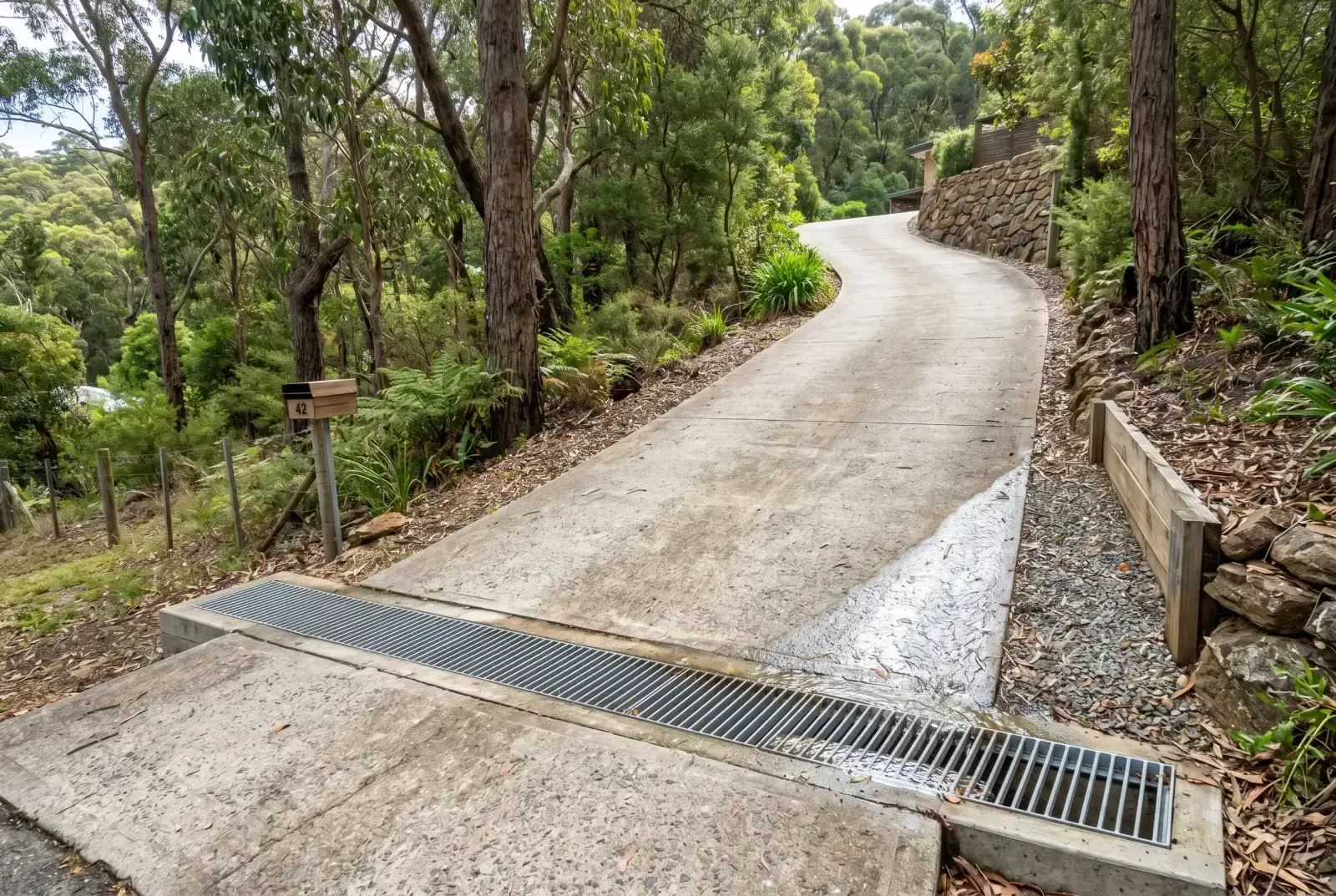
On a steep block, drainage is every bit as important as the concrete itself. Get the falls and the water management wrong and even a perfectly poured slab will undermine, crack, or turn into a slip hazard within a few wet winters.
We've poured a lot of driveways across the Adelaide Hills, and the ones that fail almost always fail because of water, not concrete. Below is how we read a slope, set the falls, build in drainage, and finish the surface so a sloping driveway sheds water, grips underfoot, and lasts.
Why does drainage matter so much on a sloping driveway?
On a slope, water moves fast and concentrates, so poor drainage causes erosion under the slab, water into the garage, and slippery, dangerous surfaces. A flat block can get away with a bit of ponding; a steep block cannot. Gravity turns every shortcut into a problem — undercut edges, scoured base material, water pooling against the house, and green slime on shaded sections.
The job of the driveway is not just to carry a car. It also acts as a giant water chute. Rain that lands on the driveway, plus run-off from the road, the garden, and the roof, all has to be directed somewhere safe. If you don't plan that, the water will choose its own path — usually straight at your garage door or down to the lowest, softest part of the block. Good drainage design is what separates a driveway that lasts 30 years from one that needs patching in five.
How do you read the slope before designing the driveway?
You read the slope by working out where water naturally wants to go, then designing falls that send it somewhere safe instead. Before any concrete is ordered, we walk the block in the wet if we can, or at least picture where the water lands and travels.
The key things we assess are:
- Overall grade — how steep is the run from the street to the garage, and is it consistent or does it change partway?
- High and low points — where does the water collect now, and where does it discharge?
- Cross-block fall — does the land also slope sideways, not just down the driveway?
- Upslope catchment — what's above the driveway sending run-off onto it (the road, a neighbour's block, a hillside)?
- The garage threshold and house levels — these are fixed points the design has to protect.
Steep Hills blocks often need site cutting and benching before you can pour a workable grade at all. That's where proper earthmoving and site preparation earns its keep — getting the levels right with machinery first makes the concrete far easier to drain.
What's the difference between crossfall and longitudinal fall?
Longitudinal fall is the slope along the length of the driveway, while crossfall is the gentle slope across its width that pushes water sideways to a drain or edge. On a sloping block you use both together.
Longitudinal fall is mostly dictated by the block — the driveway has to follow the hill. The skill is in the crossfall. A crossfall of around 1 in 50 to 1 in 40 (roughly 20–25mm per metre of width) tips water off the surface sideways instead of letting it race straight down the centre and build up speed. Sending water to one edge, where a channel drain or a kerbed edge can catch it, is far better than letting a sheet of water sprint toward the garage.
The other golden rule near the house: always fall away from the building. The last couple of metres before the garage should tip back toward a drain, never into the building. We'd rather over-build the drainage at the garage than ever risk water getting under the door. For the technical detail on grades, thickness and falls, our guide to driveway thickness, slope and drainage goes deeper.
How do you stop cars scraping at grade changes?
You stop cars bottoming out by smoothing the transitions where the slope changes angle, using vertical curves rather than a sharp kink. The most common scrape points are at the bottom (where a steep driveway meets the flatter road or footpath) and at the top (where it levels off into the garage).
If the grade changes too abruptly, a low car will catch its front bumper on the way down and its underbody on the way up. We design a transition zone — a gradual easing of the slope over a metre or more — so the angle change is spread out. On really steep blocks this can mean the difference between a usable driveway and one where every visitor leaves paint on the concrete.
Getting transitions right is part planning and part experience. We string-line and check levels carefully, and on tight blocks we'll mock up the worst grade change before committing. It's one of the most important parts of building a steep concrete driveway properly.
What drains do you use, and where do they go?
The workhorse on a sloping driveway is the grated channel drain, set across the driveway near the bottom to capture run-off before it reaches the garage or the street. Different drains suit different jobs:
- Grated channel (strip) drains — a slotted channel running across the full width, sitting flush with the surface. Best placed at the base of a slope, just before the garage, and sometimes partway down a long run to break up the flow. They catch sheet water across the whole width.
- Spoon drains — a shallow dished channel formed into the concrete itself. Good for guiding water along an edge or directing it toward a pit without a metal grate.
- Slot drains — a discreet narrow slot for a cleaner look where a wide grate would stand out.
- Pits and grated inlets — collection points at low spots that feed into the stormwater pipe.
Placement is everything. A channel drain at the top of a steep section protects the garage; one at the bottom stops water sheeting onto the footpath and road. We size the channel and grate to the volume of water the catchment will throw at it — undersized drains overflow in the first big storm.
How does the driveway connect to stormwater?
Drains on a sloping driveway should connect into the property's stormwater system or an approved discharge point, never just spill onto a neighbour's land or across the footpath. Channel drains and pits are piped to the legal stormwater connection — typically the street kerb, an existing stormwater main, or a soakage system where the soil and council rules allow.
Discharging water correctly matters for two reasons: it protects your own block from erosion, and it keeps you on the right side of drainage and council requirements. Where a driveway meets the road, the way water is handled at the boundary often ties in with crossover and footpath rules too. We make sure the falls, the drains and the connection all work as one system rather than three separate afterthoughts.
How do you manage overland flow and erosion?
You manage overland flow by intercepting upslope water before it reaches the driveway and by armouring the points where water leaves the slab. On Hills blocks, the run-off from above is often the real culprit — a hillside or a neighbouring property dumping water onto your driveway during a downpour.
The fixes we use include:
- A cut-off drain or swale above the driveway to catch hillside run-off before it lands on the concrete.
- Rock or rubble aprons at discharge points so the water doesn't scour the soil where it exits.
- Edge protection and retaining where the driveway is cut into a bank, so the slab edge isn't undermined.
- Proper compaction and a stable base, so water can't wash out the material under the slab.
Erosion control is invisible when it works and obvious when it doesn't — a slab with a washed-out edge or a sinking corner is almost always a drainage failure underneath.
What's the best finish for grip on a shaded, damp slope?
For grip on a steep, shaded driveway we recommend exposed aggregate, because its textured surface holds traction far better than a smooth trowelled finish when wet. Many Adelaide Hills blocks have sections that sit under tree cover or on a southern aspect, so they stay damp and grow algae — and a slick driveway on a slope is genuinely dangerous.
Exposed aggregate gives you a stone surface with plenty of texture, looks at home in a leafy Hills setting, and sheds water well. Where a client prefers a different look, a broom finish run across the fall also gives good grip. What we avoid on steep, shaded driveways is a smooth steel-trowel finish — it's an accident waiting to happen. If you're weighing up the options, our post on choosing a driveway finish in the Adelaide Hills walks through the trade-offs.
Does a steep driveway need thicker concrete and more reinforcement?
Yes — a steep, heavily-used driveway generally warrants a thicker slab and proper steel reinforcement, because it carries more load stress and sits on ground that's more prone to movement. A standard residential driveway is commonly poured around 100mm, but on a steep block, with heavier vehicles or reactive clay underneath, we'll often increase that and pay close attention to the reinforcement and base.
Reinforcing mesh, correctly positioned in the slab (not lying on the ground), helps the concrete hold together if the ground moves and keeps cracks tight. The base matters just as much — a well-compacted, well-drained base stops the slab from rocking and cracking. We also set out control joints to manage the cracking that all concrete does, and we use the falls and joints together so water never sits on the surface. Our explainer on why concrete cracks and how we prevent it covers the joint and reinforcement detail.
What about retaining and edges on a cut driveway?
Where a driveway is cut into a slope, the exposed bank needs retaining and the slab edges need support so they don't fail. A driveway carved into a hillside will have a high side that wants to slump and a low side that wants to drop away. Both need addressing — retaining walls or batters on the high side, and proper edge thickening or support on the low side. We coordinate the cut, the retaining and the drainage so the whole thing works as a unit, which again is where machine site prep up front pays off.
Frequently asked questions
How steep is too steep for a concrete driveway? Most cars cope with a driveway up to around 1 in 4 (25%) if the transitions are designed well, but the steeper it gets, the more critical the grade changes, grip finish and drainage become. We assess each block individually — a steep driveway can absolutely work, it just has to be designed properly.
Will a channel drain across the bottom be enough? Often a single channel drain at the base, combined with good crossfall, handles a typical block. But where there's a lot of upslope catchment or a long, steep run, we'll add a second drain partway up or a cut-off drain above the driveway. It depends on how much water the site sheds.
Can you fix drainage on my existing sloping driveway? Sometimes — we can retrofit channel drains, regrade sections, or improve edge drainage. But if the slab is cracking or the base is washing out, you may be better off replacing it. Our post on the signs your concrete driveway needs replacing can help you decide.
Do you work across the whole Hills region? Yes. We pour sloping driveways throughout the Adelaide Hills and the Mount Barker district, where steep, reactive and shaded blocks are part of everyday work for us. After 25 years in the area, there aren't many slopes we haven't seen.
Planning a concrete project? Get a free, no-obligation quote from Adelaide Hills Concreting — 25 years across the Adelaide Hills, Morgan, the Riverland and the Mid North.