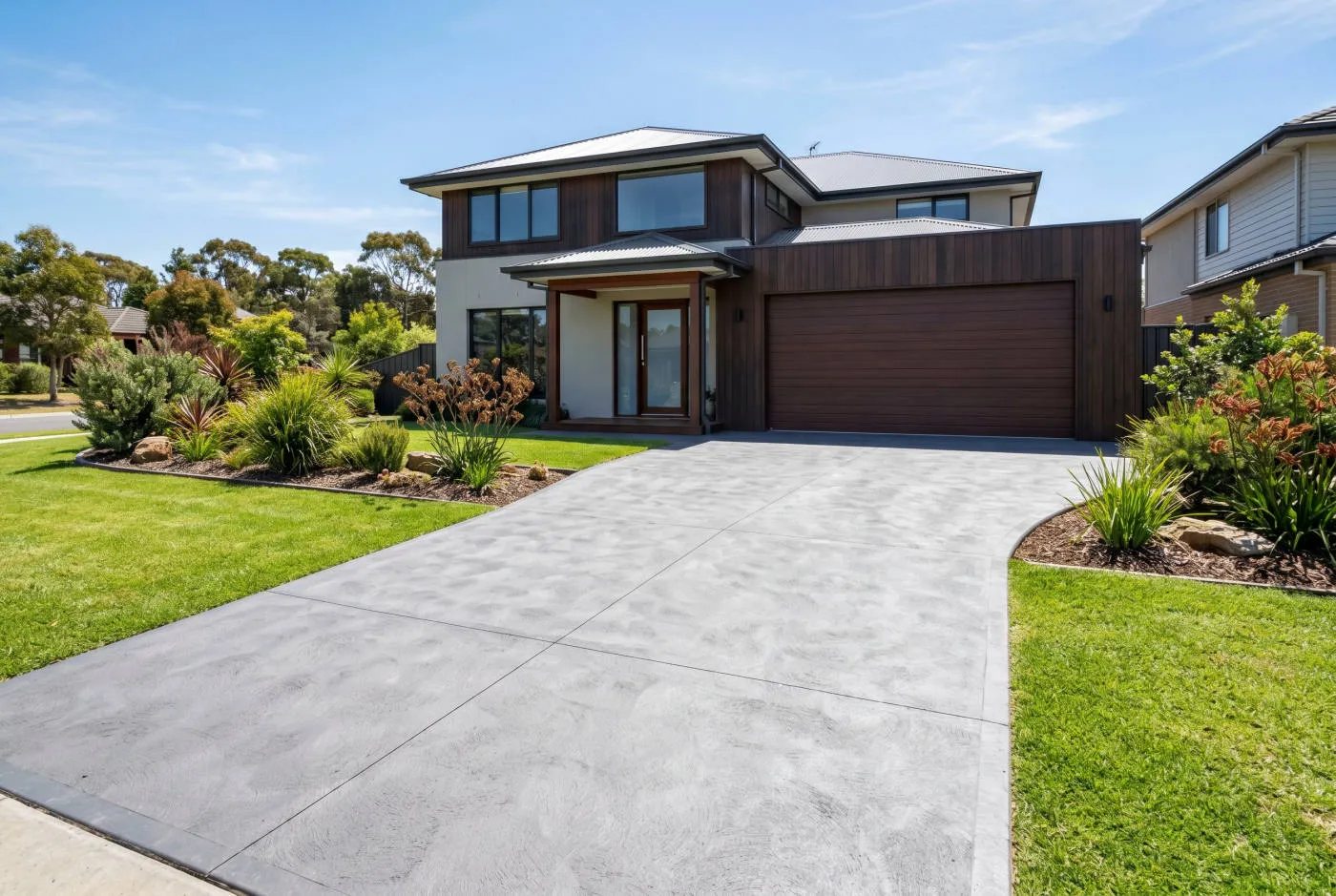
Two driveways the same size can come back with very different quotes, and homeowners are often surprised by the gap. The price isn't pulled out of the air. It tracks a handful of real factors that change how much material, labour and machinery the job needs. Here's where the money actually goes, so you can read a quote with confidence.
What are the main factors that affect a driveway price?
The price of a concrete driveway is driven mainly by size, finish, access, ground conditions, reinforcement, the council crossover and drainage. Get a handle on these seven and you'll understand most of any quote you receive.
- Size and thickness
- The finish you choose
- Site access and slope
- Excavation and base preparation
- Reinforcement
- The council crossover
- Drainage
Below we break each one down, then cover a few extra things that can move the number. For real-world ranges on each, our concrete driveway cost guide for SA puts figures around the factors discussed here.
1. How do size and thickness affect the price?
Size and thickness are the biggest single drivers, because together they set how much concrete you actually buy. Area is obvious: a longer, wider driveway needs more of everything. Thickness is the part people overlook, and it matters just as much.
A driveway carrying nothing heavier than family cars can be poured thinner than one a caravan, boat trailer, horse float or delivery truck will use. Going thicker uses more concrete across the whole area, and it usually means heavier reinforcement to match, so the cost climbs on two fronts. A good concreter sets the thickness to your actual use rather than guessing, because under-building to save concrete is the fastest way to a cracked, sunken slab. You can see how we approach this on our concrete driveways page.
2. How does the finish change the cost?
The finish is one of the easiest ways to move a quote up or down, because it changes both materials and labour. Plain grey concrete with a broom finish is the most affordable option. Decorative finishes cost more for good reason.
- Broom finish: The standard, hard-wearing, cost-effective choice.
- Coloured concrete: Adds the cost of oxides or colour hardener through the mix or surface.
- Exposed aggregate: More expensive again, because it uses a specific decorative stone mix and a more involved finishing process to wash back and reveal the aggregate.
Exposed aggregate looks superb and wears extremely well, but it's a more skilled, more labour-intensive finish, which is reflected in the price. If you're weighing up the look, our exposed aggregate service page covers what's involved, and there's more on the trade-offs in our cost detail. The finish is a genuine choice between budget and appearance, not a hidden cost.
3. How do site access and slope affect the quote?
Difficult access and steep slopes add labour, and labour adds cost. If trucks and machinery can get straight to the work area, the job runs efficiently. If they can't, the crew has to work harder to move material and concrete into place.
Tight side access, narrow gates, retaining walls and existing landscaping all slow things down. A steep block, common across the Adelaide Hills, adds work too: more careful set-out, more formwork to hold falls and edges, and often safety measures for working on a grade. Where a truck can't reach with a chute, the concrete may need to be pumped, which is an extra cost we cover further down. If you've got a tricky or sloping site, it's worth flagging early so it's priced properly rather than discovered on the day. We work plenty of challenging blocks across the Adelaide Hills, so steep and tight sites are familiar ground.
4. How do excavation and base preparation affect cost?
Excavation and base prep cost more on difficult ground, and this is one of the parts of a quote you should never see skimped. Before any concrete goes down, the site is stripped, levels and falls are set, and a compacted crushed-rock base is laid. The harder the ground and the more there is to move, the more this stage costs.
Reactive clay soils, rock, tree roots, or a site that needs significant cut-and-fill all add to the excavation. So does carting spoil away if there's nowhere to keep it on site. The base is the foundation the whole driveway sits on, so paying for proper preparation here is money well spent. Where bigger earthworks are involved, our earthmoving and site prep service handles the heavy lifting. A cheap quote that quietly cuts the base is a false economy.
5. How does reinforcement affect the price?
Reinforcement scales with how hard the driveway will work, so heavier-duty jobs cost more in steel. Reinforcing mesh or steel fibre controls cracking and helps the slab carry load and bridge minor ground movement. A driveway that only ever sees cars needs less than one built for heavy or commercial vehicles.
Heavier-gauge mesh, closer spacing, or a thicker slab with matched steel all add cost, but they're what keeps a hard-working driveway intact. Reinforcement is also closely tied to crack control, which we explain in our guide on why concrete cracks and how we prevent it. As with thickness, the right answer is set by your use, not by what's cheapest.
6. How does a council crossover add to the cost?
A new or upgraded crossover, the section of driveway between your boundary and the road, can add meaningfully to a project. The crossover often has to meet council standards, which can dictate dimensions, materials and how it ties into the kerb and footpath.
If your job needs a new crossover or changes to the existing one, that's extra concrete, extra works and sometimes a council approval process. Requirements and approvals vary, so we point readers to our driveway council approval guide for SA rather than quoting specifics. It's worth sorting the approval side early, because it can affect both your timeline and your budget.
7. How does drainage affect the cost?
Drainage adds cost wherever water needs to be actively managed, which is common on sloping blocks. A flat, well-draining site may need little more than the right surface falls. A steep or low-lying site often needs more: spoon drains, strip drains or grates, and careful grading to keep water away from the house and garage.
Getting drainage right is not optional. Water that pools or runs the wrong way undermines the base, stains the surface and, over time, leads to movement and cracking. The cost of doing it properly is small compared with fixing the damage poor drainage causes. On Hills blocks especially, falls and drainage are a core part of designing the driveway, not an afterthought.
What other things can affect a driveway price?
Beyond the main seven, a handful of other factors can nudge the number, depending on your site and choices.
- Demolition and removal of an old driveway: Breaking out and carting away existing concrete is a real cost, especially if the old slab was thick or steel-reinforced.
- Soil type and spoil removal: Difficult soils slow excavation, and getting spoil off site costs money where it can't be reused.
- Concrete pumping: Where a truck can't reach the work, a pump moves the concrete into place. It's an added cost but often the only practical option on tight or sloping blocks.
- Distance and regional delivery: Jobs further from a batching plant can carry higher concrete delivery costs, which is worth knowing in regional areas like the Riverland, the Mid North and the Morgan district.
- Sealing: Sealing a decorative finish protects and enhances it, and is an added line on the quote.
- Plumbing and services: Pipes, conduits or pits crossing the driveway path may need to be accommodated or relocated before the pour.
How can you keep your driveway cost reasonable without cutting corners?
Keep the cost reasonable by making smart choices on the things you control, not by under-building the things you can't see. The base, the thickness and the reinforcement should always be set to your real use. Where you've got room to economise is in the finish and the extras.
- Choose a broom finish over a decorative one if budget is tight.
- Improve access where you can so machinery works efficiently.
- Sort out crossover approvals early to avoid delays.
- Get a fully itemised written quote so you can see exactly where the money goes.
Frequently asked questions
Why is exposed aggregate more expensive than plain concrete? It uses a specific decorative stone mix and a more involved, more skilled finishing process to wash back and reveal the aggregate. The extra material and labour are reflected in the price, and you get a finish that looks excellent and wears very well.
Does a sloping block always cost more? Usually, yes. Slopes add formwork, careful set-out, drainage and sometimes pumping. None of it is a deal-breaker, it just needs to be priced and built properly, which is routine on Hills blocks.
Will I need council approval for my driveway? Often the crossover and access onto the road require council involvement, and requirements vary. Check our council approval guide and sort it early.
Is the cheapest quote a good idea? Rarely. A quote well below the others usually leaves out base, thickness or steel, which is exactly where durability lives. Compare quotes on the same scope, then choose on value.
How do I get an accurate price for my driveway? The only way to a reliable number is a proper site assessment, because access, slope, ground and crossover all vary. For ballpark ranges first, read our driveway cost guide, then get a fixed written quote for your actual site.
Planning a concrete project? Get a free, no-obligation quote from Adelaide Hills Concreting — 25 years across the Adelaide Hills, Morgan, the Riverland and the Mid North.