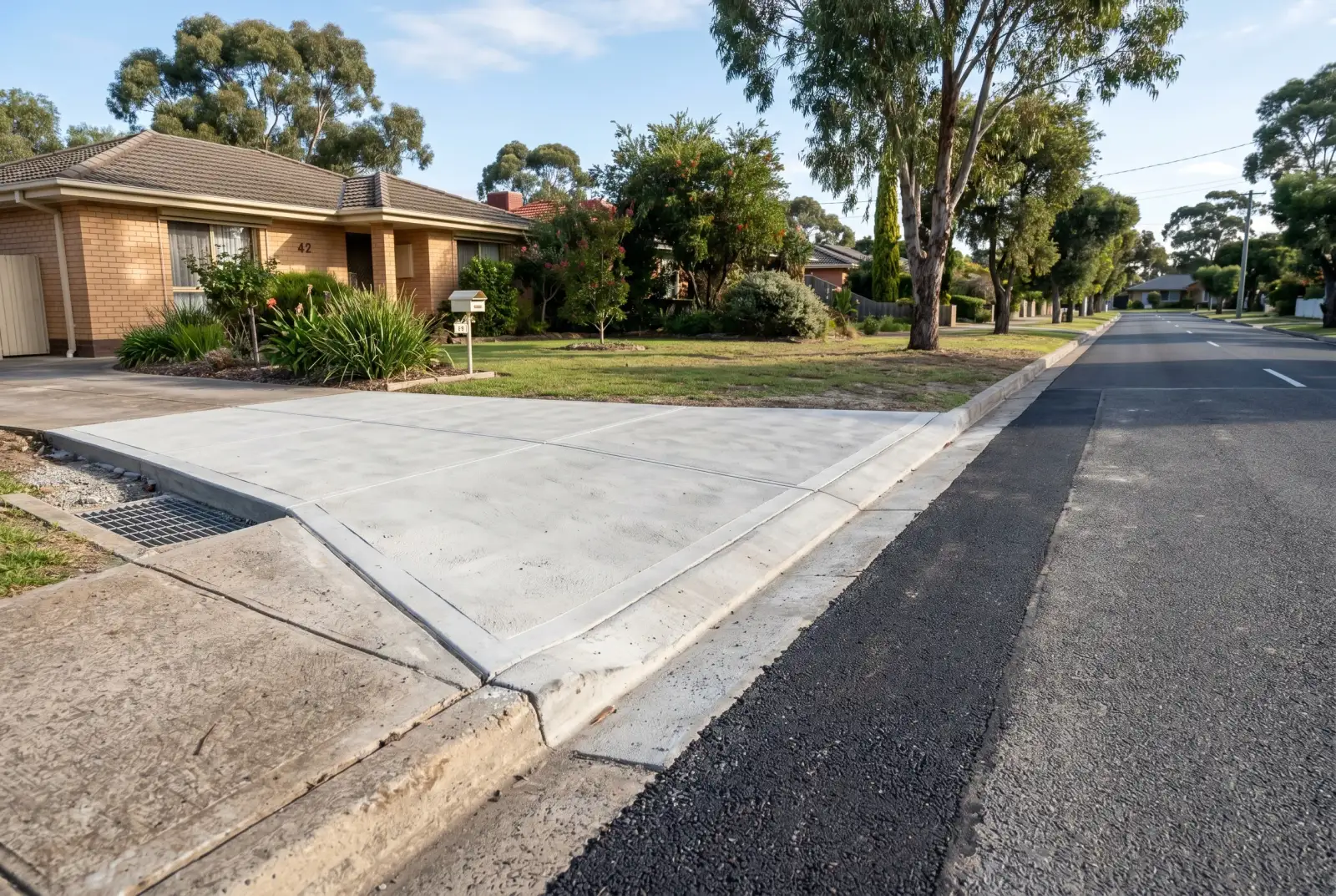
If you're putting in a new driveway or changing where it meets the road, you'll run into the term "crossover" — and the council rules that come with it. It's the one part of a driveway job that isn't entirely on your own land, and that changes how it has to be built.
Here's a plain-English run-through of what a crossover is, when it needs approval, and how we build it to the standard profile so it passes inspection the first time.
What is a driveway crossover?
A crossover is the section of driveway between the road and your property boundary — the bit that crosses the council road reserve, including the kerb layback and the verge. Everything from your boundary inward is your private driveway; everything from the boundary out to the road sits on land the council controls, even though it's the part you drive over every day.
That distinction matters because the crossover and the on-property driveway are treated differently. Your driveway is yours to design within reason. The crossover has to be built to the council's standard, because it's in public road reserve and has to work safely with the road, the kerb, the footpath and underground services. People often think of the whole thing as one driveway, but in practice it's two jobs that have to tie together seamlessly.
Who owns the crossover, and who maintains it?
The crossover sits in council road reserve, so the council controls the standard it's built to, but the property owner is usually responsible for the cost of constructing it and often for maintaining it. In other words, you pay for it and look after it, but you don't get to decide how it's built — the council does, through its published standards.
This is why you can't simply pour concrete from your garage out to the road and call it done. The crossover portion has to meet the council's requirements for width, grade, depth, finish and how it joins the kerb. Getting that wrong can mean tearing it out and starting again, so it pays to do it right from the start.
Does a crossover need council approval?
Yes — a new crossover, or any modification to an existing one, almost always needs council approval before work starts. Because the work is in the road reserve and affects public infrastructure, councils require an application and usually an inspection of the work.
You'll generally need approval when you:
- Build a brand-new crossover where there wasn't one.
- Widen or move an existing crossover.
- Change the kerb (for example, cutting a kerb for a new layback).
- Add a second crossover to a property.
Even resurfacing or rebuilding a worn crossover can trigger requirements. The approval process and the standards vary between councils, so rather than guess, point yourself to our guide on driveway council approval in SA, which walks through how the process generally works. The safe rule: if the work touches the road reserve, assume you need approval and check before you dig.
What does the approval and inspection process look like?
In general terms, you lodge an application with the council, build the crossover to their standard, and have it inspected before and/or after the pour. While the exact steps differ by council, the typical path looks like this:
- Application — you (or we, on your behalf) submit details of the proposed crossover, often with a site plan and dimensions.
- Approval and conditions — the council approves the location and sets conditions, such as the width, the layback type and any sight-line requirements.
- Permit or bond — some councils require a permit fee and a security bond to cover any damage to public infrastructure during the work.
- Inspection of the prepared base — many councils inspect the formwork, base and reinforcement before the pour.
- Construction to standard — the crossover is poured to the published profile.
- Final inspection — the finished crossover is checked, and the bond is released once it passes.
Because we've built crossovers across many SA councils, we're used to working to whichever standard applies and to lining up the inspection at the right stage so the job isn't held up.
What are the standard crossover dimensions?
Each council publishes a standard crossover profile that sets the width, depth, grade, reinforcement and finish, and we build to that exact profile. While the numbers vary, the things a standard typically specifies include:
- Width — minimum and maximum widths, often different for residential and commercial, and rules on how close it can sit to side boundaries and intersections.
- Slab thickness and reinforcement — crossovers are usually thicker and more heavily reinforced than a private driveway because they carry traffic loads and heavy vehicles like waste trucks.
- Grade — limits on the slope so vehicles don't scrape and water drains correctly.
- Kerb and layback type — how the crossover meets the kerb, whether it's a layback (rolled or laid-back kerb) or a kerb that's cut and reformed.
- Finish — usually a non-slip broom or similar finish, and sometimes a requirement for a particular look near heritage or main roads.
Building to the published profile is the whole point — a crossover that doesn't match the standard won't pass inspection. For the private side, our concrete driveway service covers everything from the boundary inward, and we make sure the two halves meet cleanly.
How do sight lines and vehicle access affect a crossover?
Councils require crossovers to be placed and sized so drivers have clear sight lines and can enter and exit safely without conflicting with pedestrians or other traffic. The location isn't just about what's convenient for your garage — it's about safety on a public road.
That means a crossover usually can't be too close to an intersection, a corner, traffic signals, a bus stop, or street furniture. There may be minimum distances from these, and rules to preserve visibility for both the driver leaving the property and pedestrians on the footpath. On a busy or curved road, this can dictate exactly where your driveway has to go. We factor sight lines in early so the approved location works with the driveway layout, not against it.
What about services in the verge?
The verge between your boundary and the road is full of underground and above-ground services — water, gas, electricity, telecommunications, stormwater pits, and sometimes street trees — and the crossover has to work around them. Before any digging, the services in the area need to be identified so nothing gets struck.
Sometimes a service pit, a power pole, a stobie pole or a street tree sits right where the crossover wants to go, and that affects the location or means an authority has to be involved to relocate or protect the service. This is a common reason a crossover ends up where it does rather than dead-centre on the driveway. It also ties in with the public footpath, which the crossover crosses — that section has to be reinstated to standard too.
Why do crossovers fail inspection?
Crossovers most often fail inspection because they weren't built to the council's standard profile — wrong width, wrong grade, thin slab, poor finish, or a bad join to the kerb. The common reasons we see jobs fail when someone's tried to cut corners include:
- Slab too thin or no reinforcement where the standard requires it.
- Grade too steep, so vehicles scrape or water doesn't drain.
- Levels that don't match the kerb or footpath, leaving lips or ponding.
- Poor falls, allowing water to pool on the crossover or run the wrong way.
- Damage to the kerb or footpath left unrepaired.
- No inspection booked at the base stage, so the council can't verify what's under the concrete.
Every one of these is avoidable by building to the profile and lining up inspections properly — which is exactly what we do.
How do you tie the crossover into the new driveway?
We match the levels, falls and finish at the boundary so the crossover and the private driveway flow together as one smooth surface. The crossover is built to council standard, and the driveway is built to suit your block, but the two have to meet at the boundary without a lip, a hump, or a low spot that holds water.
That means planning the falls across both sections together, aligning joints where it makes sense, and carrying a consistent finish across the join so it doesn't look like two separate pours. Done well, you shouldn't be able to tell where the council standard ends and your driveway begins.
Frequently asked questions
Can I build the crossover myself? The crossover is in public road reserve and must meet council standards and inspections, so it's not a job to wing. Many councils require the work to be done to their profile and inspected, and some require approved contractors for the kerb works. We handle crossovers as part of the driveway so the whole thing is built right and passes.
How long does crossover approval take? It varies by council, from a couple of weeks to longer if there are services or sight-line issues to resolve. We recommend starting the approval early, before you lock in a pour date. Our council approval guide explains the general timeline.
Do I need approval to just resurface my crossover? Often yes — any work in the road reserve can trigger requirements, even a rebuild of a worn crossover. Always check with your council first rather than assume it's exempt.
Who do I talk to about my crossover? Start with us — we build crossovers throughout the Adelaide Hills and Mount Barker district and can guide you through the council side. Get in touch and we'll work out what your block needs.
Planning a concrete project? Get a free, no-obligation quote from Adelaide Hills Concreting — 25 years across the Adelaide Hills, Morgan, the Riverland and the Mid North.